
Transformer Ratings: kVA, MVA and Selection Checks

Last updated:
Two offers can show the same kVA and still describe different usable duties. One may state capacity with natural cooling; the other may depend on fans. Before comparing prices, you need to know what conditions support each number.
Transformer ratings express apparent-power capacity in kVA or MVA under stated operating conditions. Read that capacity alongside voltage, frequency, phase, cooling and heat limits. A load sum gives you demand. It doesn’t prove that the proposed unit suits the site.
This guide explains how to read transformer ratings, check the useful arithmetic and compare proposals on a common basis. It also shows where general rating checks hand off to specialist BESS sizing.
Keep three figures apart: the load you need, the size you choose and the rating the bidder confirms for your site. List future loads by name. Don’t add the same spare margin to every load sum. Ask the bidder to identify the cooling stage and operating basis behind the quoted capacity.
For the wider equipment context, start with our power transformer guide.
Transformer ratings in kVA and MVA: what the number means
Apparent power, kW and the load boundary
Apparent power comes from voltage and current. Real power, in kW, does work or makes heat in the load. Divide real power by apparent power to get power factor. This ratio links the two; it isn’t spare capacity.
Transformer ratings use apparent power. Current and voltage set limits even when the real-power load is lower. Winding losses depend on current, while voltage and frequency affect the magnetic operating condition.
Reactive demand adds current. It isn’t all lost as heat in the windings.
ABB’s transformer sizing guide explains the conversion from kW using power factor. For a known real-power load, use kVA = kW / power factor. Use the power factor for that load and mode. Don’t use one average for all motors or buildings.
Illustrative scenario: a kW-only selection. A load draws 100 kW at an assumed power factor of 0.85. Its apparent-power demand is 100 / 0.85 = 117.6 kVA. A 100 kVA candidate is below that stated demand.
This shows a shortfall. It doesn’t tell you when a given unit would get too hot or fail.
If sound current and voltage data already give you kVA, don’t divide by power factor again. Note where each input comes from. State which side of the unit it describes.
One MVA equals one thousand kVA
For transformer ratings, one MVA equals 1,000 kVA. Thus, 2,500 kVA and 2.5 MVA express the same apparent power. A change of units doesn’t change the build, voltage class or duty.
Use MVA to keep large numbers short. The change of units doesn’t create a new class of equipment. Use the same units in the load list and bid sheet. This helps avoid a scale error. For application differences, see our power and distribution transformer comparison.
Read transformer ratings together on the nameplate
Transformer ratings need a clear basis to be useful. Read the nameplate with the approved data sheet. If the bid leaves a field open, ask what it means before you accept it.
Eaton’s specialty transformer design guide, particularly its selection, glossary and application sections, explains why voltage, frequency, temperature and load conditions belong in this review. Its stated product values don’t apply to every transformer.
| Field | What it tells you | What to confirm in the offer |
|---|---|---|
| kVA or MVA | Apparent-power capacity on a stated basis. | Continuous duty, applicable winding and cooling stage. |
| Winding voltages and taps | Voltage ratio and adjustment options. | Supply range, required load voltage and tap operating restrictions. |
| Frequency and phase | Electrical operating basis. | The exact proposed unit’s approved supply conditions. |
| Connections or vector group | Winding connections and phase displacement. | Neutral, grounding, protection and parallel-operation requirements. |
| Percentage impedance | A parameter affecting voltage drop and fault current. | Rated-power, temperature and tap basis used in system studies. |
| Cooling designation | How heat is removed. | Capacity available with each declared cooling state. |
| Temperature rise and insulation system | Separate thermal design quantities. | Declared rise, ambient basis and insulation-system rating. |
Voltage, frequency, phase and winding connections
An illustrative 11 kV/415 V ratio identifies two winding voltage levels. It doesn’t tell you the tap range or allowed supply changes. Nor does it prove the unit suits every 415 V load. Ask which tap positions are available and what capacity applies at the required position.
Transformer ratings must also suit the supply frequency. Use the stated rating. Ask the maker to approve any other use.
A dual-frequency design may state ratings for both supplies. A unit with one stated frequency needs its own review. A general formula can’t grant approval. Avoid treating an adjusted-voltage calculation as permission to operate it.
Check phase and winding details too. A vector group records winding connections and the phase shift between them. It doesn’t tell you which one suits every site. Grounding and protection must suit the system. Our three-phase and single-phase transformer comparison explains the basic arrangement choices.
Impedance, cooling and thermal fields
Impedance is one of the transformer ratings used to check fault current and voltage drop. It does not, by itself, define the complete system fault duty. The designer must check the supply network too. Allow for tolerances and other fault sources.
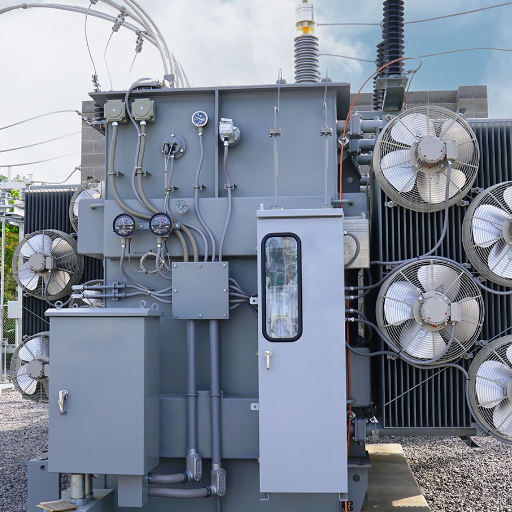
Cooling can give a unit more than one set of transformer ratings. ONAN uses natural oil and air circulation; ONAF adds forced air. Confirm the normal cooling state and the permitted load if fans are unavailable. Our transformer cooling-class guide develops that comparison.
Don’t confuse temperature rise with the insulation-system rating. Rise is the increase above the stated ambient reference. The insulation system has its own rating.
A lower declared rise does not automatically authorize extra load. These fields state the heat limits tied to transformer ratings. They don’t grant spare load unless the maker approves it.
Calculate the load without counting headroom twice
Start with a load list. Separate the sum of all connected loads from the loads that must run at once. Note measured demand if you have it. Add each mode the owner needs.
Give each spare circuit or future load a purpose. State how much power it needs.
ABB’s sizing guidance separates demand, growth and operating conditions. It does not prescribe one spare-capacity percentage for every project. When checking transformer ratings, avoid adding growth again if the approved demand schedule already includes it.
Use voltage and current from the same winding
These equations use volts and amps to give kVA. For a balanced three-phase load, use RMS line-to-line voltage. Use line current from that same winding. Schneider Electric’s capacity FAQ gives these phase-specific relationships and scoped examples.
| Available load data | Apparent-power calculation |
|---|---|
| Single-phase voltage and current | kVA = V × I / 1,000. |
| Balanced three-phase line voltage and line current | kVA = √3 × V × I / 1,000. |
| Real electrical input and applicable power factor | kVA = kW / PF. |
For a balanced 415 V, 200 A load, the result is √3 × 415 × 200 / 1,000 = 143.8 kVA. This gives apparent power. You still need duty and site checks. Do not combine high-voltage winding current with low-voltage winding voltage.
A motor’s shaft power isn’t its electrical input. Get its running and starting current. Don’t put shaft kW straight into the load list. If phases are uneven, check each phase and the neutral. The balanced formula won’t settle those limits.
Select an available rating at or above validated demand
Illustrative scenario: rounding below a requirement. A separate design case specifies 350 kW at an assumed PF of 0.85. It needs 411.8 kVA. Suppose the owner explicitly requires 25% additional capacity for a defined expansion: 350 / 0.85 × 1.25 = 514.7 kVA. The 25% is an assumed project input, not a general safety rule.
A 500 kVA candidate falls below 514.7 kVA. If the actual offered series has 750 kVA as the next suitable size, assess that candidate. Do not call 500 kVA a rounded-up result. Nor should you assume that 750 kVA is the next size in every product family.
Record why the chosen transformer ratings cover the load. Those ratings still need checks for cooling, starting and the site’s operating conditions. Size cables and overcurrent protection in their own checks. Use the rules that apply to the project.
Check duty and site conditions before accepting capacity
A safe average can hide a heavily loaded phase or a brief high load. Review the load profile and site data before signing off transformer ratings. One peak kVA value won’t answer every heat or voltage-drop question.
Starting, nonlinear loads and uneven phases
For motors, get starting current and starting method. Record how long each start lasts and the starts per hour. State the allowed voltage dip. One fixed starting factor can’t replace these data. A larger transformer or a different impedance may affect the result, but the designer must check the consequences for fault duty too.
Nonlinear loads, including converters and drives, can produce harmonic currents that affect heating. Eaton’s cited guide discusses both K-factor and harmonic-mitigating designs. A K rating concerns heat from a stated harmonic duty. It doesn’t mean that the unit removes those harmonics.
Don’t choose a K rating solely from an arbitrary percentage of nonlinear load. Ask for the expected current spectrum and duty. Ask the bidder to state the heat limits for that load. Transformer ratings for sinusoidal loads need a fresh check if the actual waveform differs.
Check individual phase and neutral currents as well as total power. Uneven single-phase loads can exceed a phase limit while total power looks safe. Check the stated limits. Don’t invent one imbalance limit for all units.
Review power-factor correction at system level too. Less reactive current may reduce kVA demand. That alone isn’t a reason to add a capacitor bank and buy a smaller unit. Check harmonics and each operating mode.
Ambient, elevation and installation conditions
Cooling depends on the environment and installation. Record site temperature and height above sea level. Note the enclosure, vents and anything that blocks airflow. Provide these as one set. A factor from a low-voltage dry-type FAQ isn’t a rule for all oil-filled or MVA units.
Illustrative scenario: an elevated site. A project needs an outdoor installation at high elevation. Instead of reducing every quoted kVA by the same percentage, the buyer asks each bidder to confirm capacity and insulation suitability for that elevation and ambient profile. Ask for the written rating basis. Don’t guess a new size.
| Condition | Evidence to request | Review responsibility |
|---|---|---|
| Motor starts | Starting profile and allowed voltage dip. | System designer with load supplier. |
| Harmonic duty | Current spectrum and thermal assessment. | Converter/load supplier and transformer bidder. |
| Uneven phases | Phase and neutral load schedule. | System designer. |
| Ambient and elevation | Site conditions and declared usable capacity. | Site designer and transformer bidder. |
| Enclosure and airflow | Installation layout and cooling requirements. | Installation designer and bidder. |
Ask for transformer ratings valid at the site, including any restrictions. One general factor won’t settle combined site conditions. Get the approved data for the proposed unit.
Compare candidate ratings on the same basis
Available transformer ratings are candidates for review. Choosing a catalogue size isn’t the whole design decision. Before comparing transformer ratings and prices, align the operating basis behind the offers.
Use an actual offered rating series
Standard sizes depend on phase, voltage class and product family. Schneider’s rating-series FAQ lists different series for single-phase, three-phase low-voltage and medium-voltage units. It lists 112.5 kVA in one series.
That’s an example from that maker. It doesn’t prove a global size list or our stock.
Ask which transformer ratings are available for the required voltage and cooling method. For distribution applications, our distribution transformer overview explains the equipment context. Confirm the exact model in the proposal rather than inferring availability from a general article.
To compare transformer ratings fairly, use two columns. Put required demand in one and site-confirmed capacity in the other. Check these fields beside each offer:
- The normal cooling state and its rated capacity.
- The allowed load if fans or other auxiliaries are out of service.
- The voltage and tap basis.
- Any excluded duty or open question.
This shows which numbers depend on extra conditions.
Separate thermal acceptance from loss and price comparison
Return to the two offers with the same kVA. If one depends on fans during normal duty, ask what capacity remains without them and which operating restriction applies. Ask both bidders to state their conditions. Then check if they match.
This doesn’t prove that either design is more reliable.
Larger transformer ratings do not automatically prove higher or lower operating cost. Get no-load and load-loss data on the same test basis. Then use the expected duty profile. Our transformer efficiency guide explains the loading context; use actual proposal data for the commercial comparison.
Keep four separate fields in the bid sheet:
- The quoted price and its scope.
- The quoted lead time.
- Losses on the agreed test basis.
- Technical exceptions that still need an answer.
An offer can pass the capacity check and still leave open questions. Check connections and site work too. A lower loss figure does not cure an inadequate site rating. Ask the bidder to close each exception before the designer accepts the proposal.
Apply the rating check to BESS operating modes
Battery energy in MWh tells you about stored energy. It does not establish the AC apparent-power duty that transformer ratings must cover. A battery energy storage system also needs defined charging, discharging and reactive-power operating cases.
Where the general rating check hands off to PCS sizing
The power conversion system, or PCS, has its own limits. Match the transformer duty to the allowed modes. State where you measure that duty. The export MW alone may leave a gap.
Must the system supply reactive power at the same time? Include that duty too.
Consider two storage projects with the same stored energy but different permitted export and reactive-support modes. Matching their MWh does not show that they need identical transformer capacity. List the required modes first. Then compare the offered MVA.
Use our BESS transformer sizing guide to define PCS operating cases, the transformer boundary and the associated capacity checks. That guide contains the detailed BESS worksheet; the purpose here is to show where the general rating review hands off.
For each permitted mode, keep the PCS data, required AC duty and site conditions together. Don’t combine separate peaks unless they must occur at once. Don’t omit an allowed combined mode just because it isn’t on the MWh label. Carry the resulting requirement back to the same nameplate and cooling checks used for other transformer ratings.
Prepare the rating review and RFQ checklist
A useful request for quotation, or RFQ, gives the bidder both the required capacity and the assumptions behind it. Start the review of transformer ratings with a load list. Mark unknown inputs clearly. If power factor or a future load is unknown, ask for it. Don’t fill the gap with an industry average.
Inputs and open questions for the bidder
Send a review pack with these inputs:
- Required kVA/MVA and the load profile used to derive it.
- Winding voltages, frequency and phase.
- Connections, neutral needs and any impedance constraints.
- Motor starts or converter duty, plus the approved future load.
- Site temperature, elevation and indoor or outdoor location.
- Enclosure, cooling, taps and installation interfaces.
- Project standards and the editions that apply.
Request a datasheet that maps these requirements to the offered transformer ratings. Ask the bidder to identify assumptions, exclusions and which capacity applies to each cooling stage. For transformer ratings to be accepted, the system designer must settle demand and system-study questions. The bidder should confirm the proposed unit’s rating basis.
For receiving and site preparation, use our pad-mounted transformer installation and receiving guide. Installation planning is a separate acceptance task, even after the capacity has been agreed.
Does every project need 25% extra capacity?
No. Use documented growth, reserve and load assumptions approved for that project. A fixed percentage can duplicate allowances already included in design demand. ABB’s linked guide makes this distinction between planned spare capacity and an automatic rule.
Can kVA be converted directly to kW?
To express transformer ratings in kW, you need the load’s power factor: kW = kVA × PF. For example, 100 kW at PF 0.80 needs 125 kVA. That requirement is 25% above the kW numeric value; a 100 kVA selection is 20% below the 125 kVA requirement. The denominator matters.
Does a higher rating guarantee lower losses?
No. Obtain comparable loss data and use the expected load profile. Transformer ratings and energy loss answer different buying questions.
Before requesting a proposal, put the load, site and operating cases into one review pack. Keep required demand, selected size and validated capacity distinct. Record the open questions and who must answer them. This makes transformer ratings useful for procurement: the final choice rests on documented duty and conditions, with exceptions resolved before acceptance.