
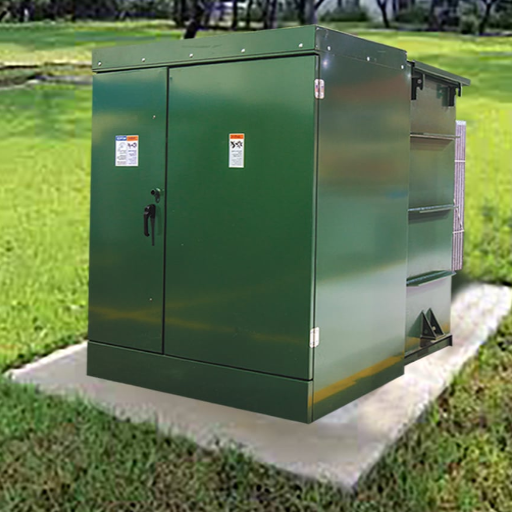
Pad Mounted Transformer: Complete Guide for Underground Distribution

A pad mounted transformer is a ground-level, oil-filled distribution transformer installed on a concrete pad inside a tamper-resistant metal enclosure. It steps down medium-voltage power (typically 4.16 kV to 34.5 kV) to low-voltage distribution (120/240V or 120/208V) for residential, commercial, and industrial loads. Over 60% of new residential developments in North America and Europe now use underground distribution, and the pad mounted transformer is the standard solution for that infrastructure.
If you are specifying distribution equipment for a new project, this guide covers design types, enclosure safety, oil containment, specifications, applications, and a selection framework to help you choose the right configuration.
Key Takeaways
- Pad mounted transformers are the standard for underground distribution, serving residential, commercial, solar, and campus applications with ratings from 75 kVA to 5,000 kVA.
- Loop feed configurations provide higher reliability than radial feed by allowing power to reach the transformer from either direction.
- Dead front designs eliminate exposed energized components, making them the required choice for public-access areas.
- Integrated oil containment systems must hold 110% of the transformer oil volume to meet EPA spill prevention requirements.
- ANSI C57.12.34 defines the standard for pad mounted transformers, covering ratings, testing, and enclosure requirements.
For detailed information on oil-immersed transformer selection (including oil selection), please refer to our oil-immersed transformer guide.
What Is a Pad-Mounted Transformer?
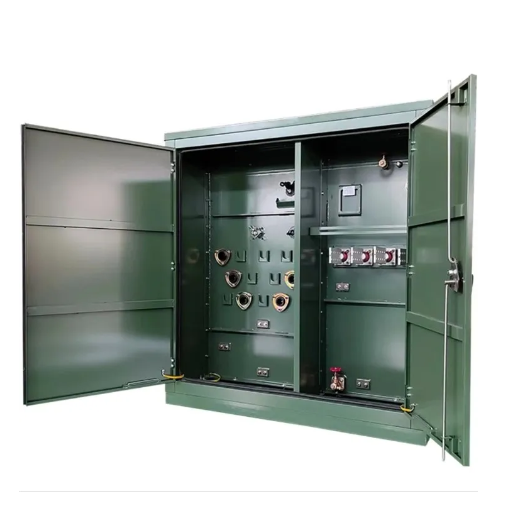
A pad mounted transformer is a self-contained, oil-immersed distribution unit mounted on a concrete pad at ground level. Unlike pole mounted transformers that hang from overhead structures, or subsurface transformers buried below grade, the pad mounted unit sits at the surface inside a locked, tamper-resistant steel enclosure.
The transformer core and coil assembly operates in insulating oil, which provides both cooling and electrical insulation. This makes the pad mounted unit a type of oil immersed transformer, optimized for safe ground-level installation. Medium-voltage power enters through cable elbows connected to high-voltage bushings, and low-voltage power exits through bushings on the opposite side of the enclosure. The entire unit is compartmentalized, separating high-voltage and low-voltage sections to protect utility workers and the public.
Pad mounted transformers are specified for any location where underground distribution is required or preferred. This includes residential subdivisions, commercial parks, shopping centers, solar farms, university campuses, hospitals, and industrial facilities. The compact footprint, quiet operation, and visual unobtrusiveness make them the preferred choice where overhead lines are restricted by zoning, aesthetics, or safety codes.
When a utility engineer named Priya designed distribution for a 500-home residential development outside Austin, Texas, the planning commission rejected overhead lines. She specified 12 three-phase pad mounted transformers with loop feed configuration and dead front design. The tamper-resistant enclosures passed OSHA inspection on the first visit, and the underground distribution system has operated without incident for eight years.
Design Types and Configurations
Selecting the right pad mounted transformer starts with understanding the available design options. Each configuration serves different reliability, safety, and capacity requirements.
Loop Feed vs. Radial Feed
A loop feed pad mounted transformer connects to the medium-voltage cable at both ends, forming a continuous loop through multiple transformers. Power can reach the transformer from either direction, which means a cable fault on one side does not interrupt service. This configuration is the standard for high-reliability applications such as residential subdivisions and commercial facilities.
A radial feed pad mounted transformer connects to a single cable run. Power flows in one direction, and a cable fault upstream of the transformer causes an outage. Radial feed costs less and works for lower-priority loads, such as parking lot lighting or temporary construction power.
Loop feed configurations provide higher reliability than radial feed by allowing power to reach the transformer from either direction. For most permanent installations, loop feed is the recommended configuration.
Dead Front vs. Live Front
A dead front pad mounted transformer has no exposed energized components. All connections are made through loadbreak elbows or bushing wells that de-energize when disconnected. This design is the standard for public-access areas and is required by OSHA and most utility standards for transformers accessible to the public.
A live front pad mounted transformer exposes some energized components, typically on the low-voltage side. Live front designs are sometimes used in utility-owned installations where access is restricted to trained personnel.
Dead front designs eliminate exposed energized components, making them the standard for residential, commercial, and public installations.
Single Phase vs. Three Phase
Single-phase pad-mounted transformers serve smaller loads, typically residential clusters or individual commercial buildings. Ratings range from 25 kVA to 250 kVA.
Three-phase pad-mounted transformers serve larger loads, including commercial buildings, industrial facilities, solar farms, and multi-unit residential developments. Ratings range from 75 kVA to 5,000 kVA. Three-phase units are the most common configuration for new underground distribution.
Compartmentalized vs. Non-Compartmentalized
A compartmentalized pad mounted transformer separates the high-voltage and low-voltage sections into distinct compartments within the same enclosure. This design allows maintenance on one circuit without affecting the other and provides an additional safety barrier.
Most modern pad mounted transformers are compartmentalized by default. Non-compartmentalized designs are rare and generally limited to legacy installations.
For outdoor installation details including foundation design and grounding, see our outdoor transformer installation guide.
Enclosure Design and Safety Features
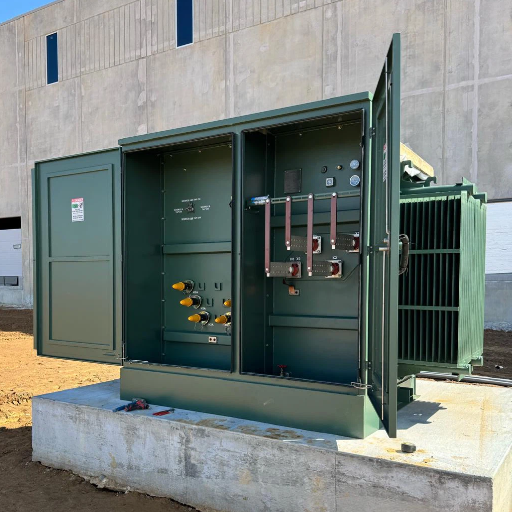
The enclosure of a pad mounted transformer is more than a weather shield. It is a safety system designed to protect the public, utility workers, and the environment.
Tamper-Resistant Design
Tamper-resistant enclosures are required by OSHA and most utility standards for transformers accessible to the public. The enclosure uses tamper-proof hardware, captive bolts, and reinforced hinges that prevent unauthorized access. Internal labyrinths or baffles prevent foreign objects from reaching energized components even if the door is pried open.
Pad mounted transformer tamper proof design is a critical safety requirement. Every unit installed in a public-access area must meet tamper-resistance standards before energization.
Weather Protection and Corrosion Resistance
The enclosure protects the transformer from rain, snow, ice, dust, and direct sunlight. Standard enclosures use powder-coated or galvanized steel for corrosion resistance. For coastal or industrial environments, stainless steel or marine-grade coatings are available.
The enclosure design also manages internal temperature. Ventilation openings are sized and positioned to allow heat dissipation while preventing water ingress.
Locking Mechanisms and Access Control
Utility-owned pad mounted transformers use utility-standard padlock provisions. The enclosure door includes a three-point latching mechanism that secures the door at the top, middle, and bottom. Some designs include a provision for a second padlock to accommodate multiple utility crews.
Visual and Physical Barriers
The enclosure height (typically 48 to 60 inches) provides a visual barrier that discourages tampering. The enclosure base extends below grade to prevent access from underneath. Warning labels and safety signage are permanently affixed to the enclosure exterior.
Oil Containment and Environmental Compliance
Pad mounted transformers use insulating oil for cooling and electrical insulation. Environmental regulations require oil containment to prevent soil and groundwater contamination in the event of a leak or rupture.
Integrated Oil Containment
Modern pad mounted transformers can include an integrated oil containment system built into the transformer base or the concrete pad. These systems are designed to hold 110% of the transformer oil volume, meeting EPA spill prevention requirements.
Integrated oil containment eliminates the need for separate containment berms or secondary containment structures, reducing installation cost and site complexity.
Spill Prevention Requirements
EPA Spill Prevention, Control, and Countermeasure (SPCC) rules apply to pad mounted transformers containing more than 1,320 gallons of oil in aboveground storage. Most distribution transformers fall below this threshold, but local regulations may impose stricter requirements.
Best practice includes a containment plan even for smaller units, especially near water sources, wetlands, or environmentally sensitive areas.
Environmental Regulations
Federal, state, and local regulations govern oil containment for pad mounted transformers. ANSI C57.12.34 includes provisions for oil containment testing and labeling. Many utilities require sealed or hermetically sealed designs to minimize oil exposure and reduce maintenance.
The choice of insulating oil also affects environmental compliance. Some projects specify ester-based fluids instead of mineral oil for improved biodegradability and higher fire point, particularly near buildings or in public spaces.
For a complete fluid comparison with selection guidance, see our transformer oil types guide.
Specifications and Ratings
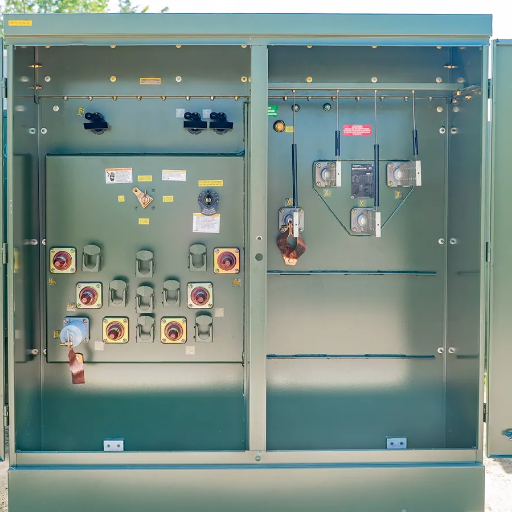
Pad mounted transformer specifications define the electrical, mechanical, and performance characteristics of the unit. Correct specification is essential for reliable operation and utility acceptance.
Voltage Ratings
Medium-voltage ratings for pad mounted transformers typically range from 4.16 kV to 34.5 kV, with 12.47 kV and 24.94 kV being the most common in North America. Low-voltage ratings include 120/240V single-phase, 120/208V three-phase, and 277/480V three-phase.
Voltage selection depends on the utility distribution system and the customer load requirements.
kVA Ratings and Typical Ranges
Pad mounted transformer ratings range from 75 kVA to 5,000 kVA for three-phase units and 25 kVA to 250 kVA for single-phase units. Common three-phase ratings include 150 kVA, 300 kVA, 500 kVA, 750 kVA, 1,000 kVA, 1,500 kVA, and 2,500 kVA.
The kVA rating must match the connected load plus an allowance for future growth. Undersizing leads to overheating and premature failure; oversizing increases cost and reduces efficiency at partial load.
Impedance and Loss Evaluation
Transformer impedance affects fault current levels and voltage regulation. Standard impedance values are defined by ANSI C57.12.34 for each kVA rating and voltage class.
No-load losses (core losses) and load losses (winding losses) affect operating cost. DOE 2016 efficiency standards set minimum efficiency levels for distribution transformers. Specifying lower-loss designs increases purchase price but reduces lifecycle cost. A solar farm developer in Arizona compared two 2,500 kVA pad mounted transformers and found that the lower-loss design saved $18,000 per year in electricity costs, paying back the price premium in under three years.
ANSI C57.12.34 Compliance
ANSI C57.12.34 defines the standard for pad mounted transformers, covering ratings from 75 kVA to 10,000 kVA. The standard specifies electrical ratings, mechanical dimensions, testing requirements, enclosure design, and safety features. Compliance with ANSI C57.12.34 is typically required by North American utilities for acceptance of pad mounted transformers on their distribution systems.
IEEE C57.12.00 defines general requirements for liquid-immersed distribution transformers and applies in conjunction with ANSI C57.12.34.
Applications of Pad Mounted Transformers
Pad mounted transformers serve a wide range of applications across utility, commercial, industrial, and renewable energy sectors.
Residential Distribution
Underground residential distribution (URD) is the largest application for pad mounted transformers. New subdivisions, planned communities, and townhome developments use pad mounted transformers to deliver power without overhead lines. Loop feed, dead front, three-phase units are the standard configuration.
Residential installations typically use 75 kVA to 500 kVA units, depending on the number of homes and load density. For a broader overview of how distribution transformers serve end users, see our guide on what a distribution transformer does.
Commercial and Industrial Sites
Shopping centers, office parks, warehouses, and manufacturing facilities use pad mounted transformers for primary distribution. These installations often require higher kVA ratings (500 kVA to 2,500 kVA) and may specify 277/480V low-voltage for three-phase commercial loads.
Commercial and industrial sites may use either loop feed or radial feed, depending on reliability requirements and utility preferences.
Solar Farms and Renewable Energy
Solar farm installations increasingly specify pad mounted transformers for step-up from inverter output to distribution voltage. A solar farm developer in Arizona needed step-up transformers for a 20 MW installation. Subsurface transformers were considered but rejected due to heat dissipation concerns in desert soil. Pad mounted transformers with forced-air cooling provided the capacity within a compact footprint, and the oil containment design met EPA requirements. The project was completed two weeks ahead of schedule.
Pad mounted transformers for solar applications typically operate at 2,500 kVA to 5,000 kVA and must handle variable loading from solar generation cycles.
Campus and Institutional Facilities
Universities, hospitals, military bases, and corporate campuses use pad mounted transformers for aesthetic and reliability reasons. A university facility manager in Ohio replaced aging overhead distribution with pad mounted transformers featuring dead front design and loop feed configuration. The compartmentalized design allowed maintenance on one circuit without affecting others, and the upgrade reduced outages by 80% compared to the previous overhead system.
Campus installations prioritize quiet operation, visual unobtrusiveness, and high reliability.
Pad Mounted Transformer vs. Alternatives
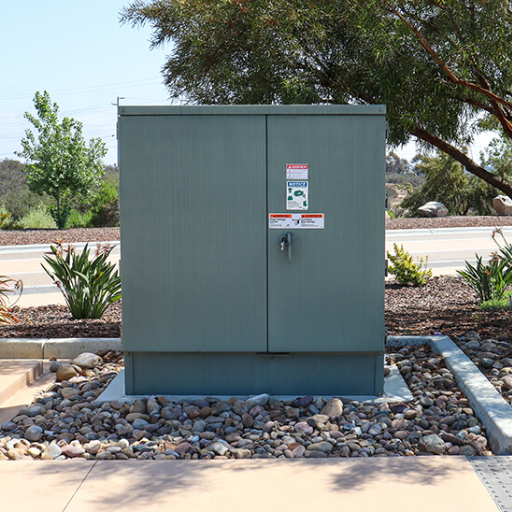
Pad mounted transformers are one of several options for distribution. The right choice depends on site conditions, aesthetics, reliability requirements, and budget.
| Factor | Pad Mounted | Pole Mounted | Subsurface | Vault |
|---|---|---|---|---|
| Installation | Concrete pad at grade | Overhead pole | Below grade | Below grade, accessible |
| Visibility | Low (ground level) | High (overhead) | None (buried) | None (buried) |
| Public Access | Enclosed, tamper-resistant | Elevated, out of reach | No direct access | Restricted access |
| Maintenance | Easy ground-level access | Requires bucket truck | Requires excavation | Manhole access |
| Cooling | Air and oil | Air and oil | Soil-assisted | Air and oil |
| Typical Use | Residential, commercial, solar | Rural, overhead systems | Urban, ultra-low profile | Dense urban, utility |
| Cost | Moderate | Low | High | High |
When to choose pad mounted: Ground-level access, tamper-resistant enclosure, underground distribution, moderate to high kVA ratings.
When to choose pole mounted: Existing overhead infrastructure, rural areas, lower cost priority.
When to choose subsurface: Ultra-low profile requirements, no visual impact acceptable, limited ground space.
When to choose vault: Dense urban environments, utility-owned underground network systems.
For indoor applications where fire safety is the priority, a dry type transformer may be a better fit than an oil-filled pad mounted unit.
Selection Guide: Choosing the Right Pad Mounted Transformer
Selecting the right pad mounted transformer requires matching the unit to your load, site, and utility requirements.
Load Assessment and Capacity Planning
Start with the connected load in kVA. Add a 20-25% allowance for future load growth. For motor loads, account for starting current. For solar applications, size the transformer for inverter nameplate capacity.
Site Conditions and Environmental Factors
Evaluate soil conditions for the concrete pad foundation. Consider flood risk, extreme temperatures, and corrosive environments. Specify stainless steel or marine-grade coatings for coastal or industrial sites. Review local oil containment requirements.
Utility Requirements and Standards
Confirm the medium-voltage class, configuration (loop feed or radial feed), and connector type with the serving utility. Most utilities require ANSI C57.12.34 compliance. Some utilities specify additional requirements for enclosure color, labeling, and grounding.
Budget and Lifecycle Cost Considerations
Compare purchase price, installation cost, and operating cost over the transformer service life (typically 30-40 years). Lower-loss designs cost more upfront but reduce electricity costs. Specify DOE 2016 compliant or better efficiency levels.
Request a detailed quotation that includes the transformer, enclosure, oil containment, accessories, and shipping. For export projects, confirm compliance with destination country standards.
Conclusion
Pad mounted transformers are the standard solution for modern underground distribution. They combine ground-level access, tamper-resistant enclosures, and oil-immersed cooling in a compact, self-contained unit. Whether you are specifying distribution for a residential development, a solar farm, or a commercial facility, the pad mounted transformer provides reliable, safe, and efficient power delivery.
The right configuration depends on your load requirements, site conditions, and utility standards. Loop feed and dead front designs provide the highest reliability and safety for most applications. ANSI C57.12.34 compliance ensures acceptance by North American utilities.
If you need help specifying a pad mounted transformer for your project, send your voltage, kVA rating, and site conditions to our engineering team. We manufacture pad mounted transformers to ANSI and IEC standards, with custom configurations available for export worldwide.
Contact our engineering team for specifications and custom configurations