
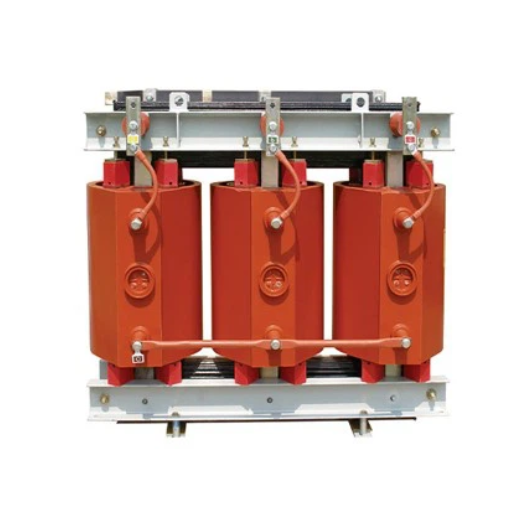
Dry Type Transformer Sizing: Complete Methodology & Examples (2026)

Dry type transformer sizing follows a clear sequence. Start with the total connected load in watts, divide by the load power factor to get kVA, apply a diversity factor based on load type, add a 20-30% growth margin, then round up to the next standard kVA rating. For three-phase units, the base formula is kVA equals square root of three multiplied by line voltage multiplied by line current, divided by 1,000. Get this wrong, and you either waste capital on excess capacity or risk premature failure from chronic overheating.
An estimated 40% of transformer-related failures originate from undersizing or misapplication, not manufacturing defects. Many engineers either ignore diversity factors entirely or apply generic margins without understanding the load profile. This guide provides a step-by-step dry type transformer sizing methodology you can apply to commercial buildings, factories, hospitals, solar plants, and data centers. You will leave with formulas, diversity factor tables, worked examples, and a procurement-ready checklist.
Key Takeaways
- Start sizing by inventorying the connected load, then convert watts to kVA using the actual power factor.
- Apply diversity factors between 0.5 and 0.9 depending on whether the load is lighting, HVAC, motor, IT, or process.
- Add a 20-30% growth margin for commercial buildings and 30-40% for industrial expansions.
- Derate for ambient temperature above 40 degrees C or altitude above 1,000 meters.
- Match the transformer impedance to motor inrush requirements; standard 4-6% may be too high for motor-heavy loads.
- Specify K-rated windings when total harmonic distortion exceeds 35%.
For the broader picture of dry type technologies, see our complete dry type transformer guide.
Why Correct Dry Type Transformer Sizing Matters
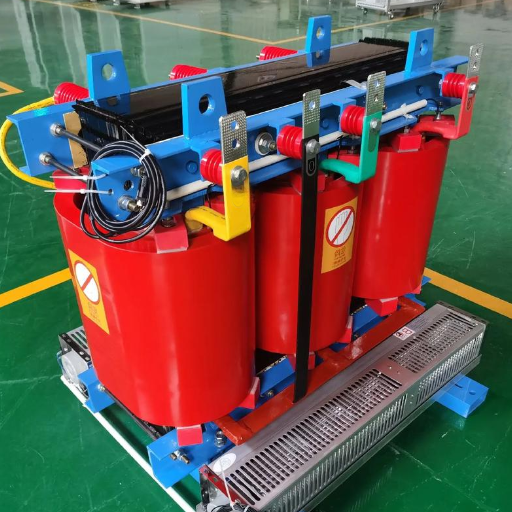
Undersizing Consequences: Overheating, Insulation Aging, Failure
An undersized transformer operates above its rated temperature rise. The extra heat accelerates insulation aging according to the Arrhenius rule. For every 10 degrees Celsius above the rated hot-spot temperature, insulation life halves. A transformer designed for 30 years of service at 100 K rise might last only 8-10 years if chronically overloaded by 20%. The failure mode is gradual at first, then sudden. Insulation resistance declines, partial discharge increases, and eventually a winding short occurs.
Oversizing Consequences: Excess Capital, Higher Losses, Poor Voltage Regulation
Oversizing is the safer error, but it is still an error. A transformer running below 30% of rated load operates at reduced efficiency. No-load losses remain constant regardless of loading, so a lightly loaded oversized unit wastes energy continuously. Voltage regulation also suffers because the impedance drop becomes a larger percentage of the applied voltage at low load. The capital cost difference between a 1,000 kVA and a 2,000 kVA dry type transformer can exceed $8,000, money that produces no return if the load never materializes.
Right-Sizing Benefits: Reliability, Efficiency, Lifecycle Value
The right-sized transformer runs within its thermal class, achieves optimal efficiency near its design load point, and delivers the expected service life of 20-30 years. For buyers focused on total cost of ownership, right-sizing is the foundation of every other optimization, from efficiency class selection to maintenance scheduling.
A manufacturing plant in Houston installed a 1,500 kVA dry type transformer to serve a new production wing. The engineer had summed the nameplate ratings of all connected motors, lighting, and HVAC without applying a diversity factor. The actual diversified load was closer to 1,100 kVA. During the first summer, ambient temperatures in the electrical room reached 45 degrees Celsius. The undersized transformer experienced winding temperatures 30 degrees Celsius above its 100 K rise rating. Insulation resistance dropped from 2,000 megohms to 400 megohms in six months. Replacement with a properly sized 2,500 kVA unit, accounting for both diversity and ambient derating, resolved the issue. The original undersizing error cost $32,000 in emergency replacement, not counting production downtime.
The Dry Type Transformer Sizing Formula
Three-Phase Sizing Equation
For balanced three-phase systems, use this formula:
kVA = (sqrt(3) x V x I) / 1,000
Where V is line-to-line voltage in volts and I is line current in amperes.
Example: A 400 V three-phase system draws 1,443 A.
kVA = (1.732 x 400 x 1,443) / 1,000 = 1,000 kVA.
Single-Phase Sizing Equation
For single-phase systems:
kVA = (V x I) / 1,000
Where V is the voltage across the winding and I is the winding current.
Converting Watts to kVA
Most loads are specified in watts or kilowatts. To convert to kVA:
kVA = kW / Power Factor
If the power factor is unknown, use these conservative estimates:
| Load Type | Typical Power Factor |
|---|---|
| Resistive heating | 1.0 |
| Incandescent lighting | 1.0 |
| LED lighting | 0.95 |
| Induction motors (full load) | 0.85 |
| Induction motors (partial load) | 0.70 |
| Computer/IT loads | 0.90 |
| Variable frequency drives | 0.95 |
| Welding equipment | 0.60 |
Need help with your specific load profile? Send us your equipment list and operating schedule, and our engineers will calculate the correct kVA.
6-Step Dry Type Transformer Sizing Methodology
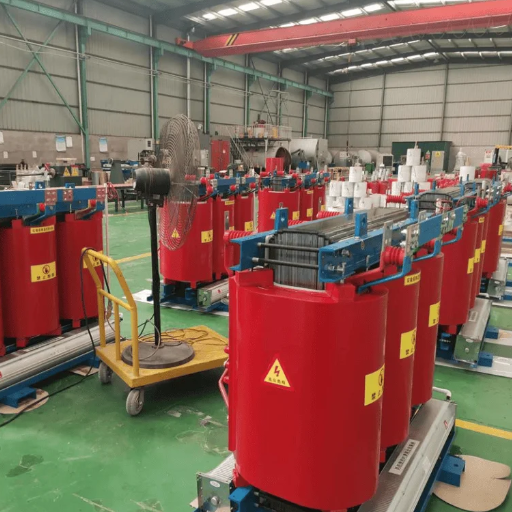
Step 1 — Inventory the Connected Load
List every piece of equipment the transformer will supply. Record nameplate power in kW or kVA for each item. Group items by load type: lighting, HVAC, motors, IT, process, and miscellaneous.
Step 2 — Categorize Load Types
Separate linear loads from nonlinear loads. Linear loads draw sinusoidal current. Nonlinear loads, such as variable frequency drives, UPS rectifiers, and LED power supplies, draw distorted current waveforms that create harmonics. Nonlinear loads may require K-rated transformers or harmonic mitigation.
Step 3 — Apply Diversity Factor by Load Category
Not all loads operate simultaneously at full power. A diversity factor reduces the total connected load to a realistic simultaneous demand. The next section provides detailed guidance on selecting diversity factors.
Step 4 — Add Growth Margin
After calculating the diversified demand, add a growth margin. For commercial buildings with stable tenancy, 20% is usually adequate. For industrial plants planning expansion, 30-40% is more appropriate. Data centers typically plan 25-30% to accommodate server refresh cycles.
Step 5 — Apply Ambient and Altitude Derating
If the installation site exceeds 40 degrees C ambient or 1,000 meters altitude, reduce the effective capacity. See the derating section for specific percentages.
Step 6 — Round Up to Standard kVA Rating
Standard dry type transformer ratings follow preferred number series. Common ratings include 100, 160, 250, 315, 400, 500, 630, 800, 1,000, 1,250, 1,500, 2,000, 2,500, 3,000, and 3,500 kVA. Always round up to the next standard size. Never interpolate between standard ratings.
Diversity Factor Selection by Load Type
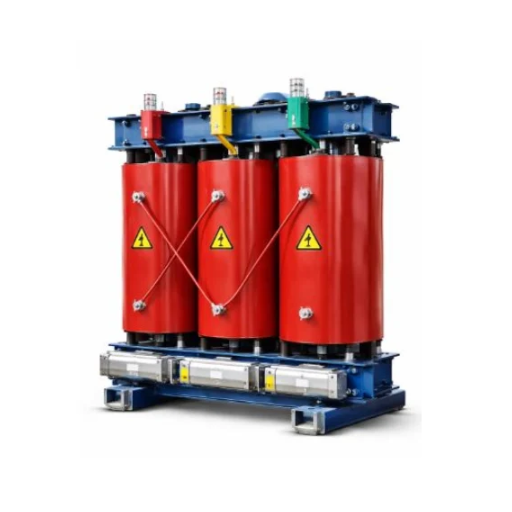
Diversity factor is the ratio of the sum of individual maximum demands to the actual maximum demand of the whole system. A diversity factor of 0.7 means the simultaneous peak load is 70% of the sum of individual nameplate ratings.
| Load Type | Diversity Factor | Rationale |
|---|---|---|
| Lighting (office) | 0.80-0.90 | Most lights on during business hours |
| Lighting (industrial) | 0.70-0.80 | Task lighting varies by shift |
| HVAC (comfort cooling) | 0.70-0.80 | Not all zones peak simultaneously |
| HVAC (process cooling) | 0.80-0.90 | Continuous industrial duty |
| Motors (intermittent) | 0.40-0.60 | Machine tools, cranes, pumps cycle |
| Motors (continuous) | 0.70-0.85 | Conveyor lines, compressors run steady |
| IT / server loads | 0.50-0.70 | Actual draw below nameplate, not all peak |
| Welding | 0.30-0.50 | Very intermittent duty |
| Elevators | 0.50-0.70 | Not all cars move simultaneously |
| General receptacles | 0.30-0.50 | Plugs used sporadically |
For mixed load facilities, calculate the diversified demand for each category separately, then sum the results. Do not apply a single diversity factor to the entire connected load.
Application-Specific Worked Examples
Example 1 — 500 kVA for Office Building
| Equipment | Nameplate (kW) | Power Factor | kVA | Diversity Factor | Diversified kVA |
|---|---|---|---|---|---|
| LED lighting | 80 | 0.95 | 84 | 0.85 | 71 |
| HVAC chillers | 150 | 0.85 | 176 | 0.75 | 132 |
| Air handling | 60 | 0.85 | 71 | 0.75 | 53 |
| Elevators | 40 | 0.80 | 50 | 0.60 | 30 |
| General receptacles | 50 | 0.90 | 56 | 0.40 | 22 |
| Fire and security | 20 | 0.90 | 22 | 0.90 | 20 |
| Total | 400 | 459 | 328 |
Growth margin at 25%: 328 x 1.25 = 410 kVA.
Standard rating: 500 kVA.
Example 2 — 1,500 kVA for Manufacturing Plant
| Equipment | Nameplate (kW) | Power Factor | kVA | Diversity Factor | Diversified kVA |
|---|---|---|---|---|---|
| CNC machines (6) | 300 | 0.85 | 353 | 0.60 | 212 |
| Welding stations (8) | 240 | 0.60 | 400 | 0.40 | 160 |
| Overhead cranes (2) | 80 | 0.80 | 100 | 0.50 | 50 |
| Compressor | 75 | 0.85 | 88 | 0.85 | 75 |
| HVAC | 120 | 0.85 | 141 | 0.75 | 106 |
| Lighting | 50 | 0.95 | 53 | 0.80 | 42 |
| Total | 865 | 1,135 | 645 |
Growth margin at 30%: 645 x 1.30 = 839 kVA.
Standard rating: 1,000 kVA.
Note: The CNC machines are intermittent loads. The compressor is continuous. Applying one diversity factor to the entire load would produce a misleading result.
Example 3 — 2,000 kVA for Hospital
| Equipment | Nameplate (kW) | Power Factor | kVA | Diversity Factor | Diversified kVA |
|---|---|---|---|---|---|
| HVAC (critical) | 400 | 0.85 | 471 | 0.85 | 400 |
| HVAC (general) | 200 | 0.85 | 235 | 0.75 | 176 |
| Medical imaging | 300 | 0.90 | 333 | 0.70 | 233 |
| Operating theaters | 150 | 0.90 | 167 | 0.80 | 134 |
| Emergency power | 100 | 0.90 | 111 | 0.90 | 100 |
| Lighting | 80 | 0.95 | 84 | 0.85 | 71 |
| General loads | 100 | 0.90 | 111 | 0.60 | 67 |
| Total | 1,330 | 1,512 | 1,181 |
Growth margin at 25%: 1,181 x 1.25 = 1,476 kVA.
Standard rating: 1,600 kVA.
Hospital loads require conservative diversity factors because critical systems must operate simultaneously during emergencies. See our hospital transformer guide for specialized medical application guidance.
Example 4 — 1,000 kVA for Solar Farm Inverter Step-Up
Solar inverter output is typically 400 V three-phase. The transformer steps up to 11 kV or 33 kV for grid connection.
| String Inverters (20 x 50 kW) | Nameplate (kW) | Power Factor | kVA | Diversity Factor | Diversified kVA |
|---|---|---|---|---|---|
| Inverter output | 1,000 | 0.99 | 1,010 | 0.95 | 960 |
| Auxiliary (tracking, controls) | 30 | 0.90 | 33 | 0.90 | 30 |
| Total | 1,030 | 1,043 | 990 |
Growth margin at 10%: 990 x 1.10 = 1,089 kVA.
Standard rating: 1,250 kVA.
Solar farms have high diversity because inverters operate near nameplate under ideal irradiance. The 10% growth margin accounts for future panel additions.
Example 5 — 3,000 kVA for Data Center Hall
For a detailed data center sizing breakdown, see our dedicated dry type transformer for data center guide.
| Equipment | Nameplate (kW) | Power Factor | kVA | Diversity Factor | Diversified kVA |
|---|---|---|---|---|---|
| IT servers | 1,500 | 0.90 | 1,667 | 0.70 | 1,167 |
| UPS losses | 70 | 0.95 | 74 | 1.00 | 74 |
| Cooling | 700 | 0.85 | 824 | 0.80 | 659 |
| Lighting and misc | 50 | 0.90 | 56 | 0.80 | 45 |
| Total | 2,320 | 2,621 | 1,945 |
Growth margin at 25%: 1,945 x 1.25 = 2,431 kVA.
Standard rating: 2,500 kVA.
Special Considerations: Motor Inrush and Starting
Motor Starting Current and Transformer Impact
Induction motors draw locked rotor current (LRA) at startup, typically 6-8 times full load current. This inrush lasts 2-10 seconds depending on motor inertia and load. The transformer must supply this inrush without excessive voltage dip that prevents motor acceleration or trips contactors.
Sizing for Largest Motor Plus Diversified Load
A conservative rule: size the transformer so the voltage dip during the largest motor start does not exceed 10-15%. Calculate the motor starting kVA, add it to the diversified load of all other equipment, and verify the transformer impedance allows acceptable voltage regulation.
When to Specify Lower Impedance
Standard dry type transformer impedance is 4-6%. For motor-heavy loads, specify 3-4% impedance to reduce voltage drop during starting. The trade-off is higher fault current, which downstream breakers must be rated to interrupt.
Soft Starter and VFD Mitigation
Modern motor controls reduce starting current. A soft starter limits inrush to 2-4 times FLA. A variable frequency drive starts at zero Hz and ramps up, eliminating inrush entirely. If the facility uses VFDs on major motors, standard transformer sizing applies without motor inrush derating.
Harmonic Loads and K-Rating
When K-Rated Transformers Are Required
Standard transformers assume sinusoidal current. Nonlinear loads generate harmonic currents that cause additional winding and core heating. When total harmonic distortion (THD) exceeds 35%, a K-rated transformer is necessary.
K-Factor Selection
| K-Rating | Maximum THD | Typical Loads |
|---|---|---|
| K-4 | 35% | Light commercial, some VFDs |
| K-13 | 60% | Data centers, standard UPS |
| K-20 | 80% | Legacy 6-pulse UPS, heavy VFDs |
| K-30 | 100% | Extreme harmonic environments |
Harmonic Mitigation vs Oversizing Trade-offs
Some engineers oversize a standard transformer by 20-30% to handle harmonic heat. This is cheaper than a K-rated unit but provides no protection against harmonic resonance and voids warranty if the manufacturer discovers the application. K-rated transformers are the correct engineering solution for high THD environments.
An office building in Munich was designed with a 2,000 kVA transformer against a calculated diversified load of only 600 kVA. The architect had specified oversized capacity to accommodate a future expansion that the tenant never pursued. For ten years, the transformer operated at 20-30% load. No-load losses consumed 4 kW continuously. Load losses were minimal due to light loading, but the unit never reached its efficiency sweet spot near 50-70% load. An energy audit revealed that right-sizing to 1,000 kVA would have saved 18,000peryearinlossesand18,000peryearinlossesand12,000 in upfront capital. The oversized unit was technically safe but economically wasteful.
Ambient Temperature and Altitude Derating
Standard Ambient Conditions
IEC 60076-11 designs dry type transformers for a maximum ambient temperature of 40 degrees C, average daily ambient of 30 degrees C, and average yearly ambient of 20 degrees C. ANSI C57.12.01 uses similar reference conditions. When actual conditions exceed these values, derate the transformer.
Derating for High-Ambient Installations
For every degree Celsius above 40 degrees C, reduce transformer capacity by approximately 1%. A transformer in a 50-degree C environment loses 10% of its rated capacity.
| Ambient Temperature | Derating Factor |
|---|---|
| 40 C | 1.00 (no derating) |
| 45 C | 0.95 |
| 50 C | 0.90 |
| 55 C | 0.85 |
Derating for High-Altitude Sites
Air density decreases with altitude, reducing convective cooling. For altitudes above 1,000 meters, derate by approximately 1% per 100 meters.
| Altitude | Derating Factor |
|---|---|
| 0-1,000 m | 1.00 |
| 1,500 m | 0.95 |
| 2,000 m | 0.90 |
| 2,500 m | 0.85 |
| 3,000 m | 0.80 |
Combined Derating Example
A 1,000 kVA transformer installed at 2,000 meters altitude with 48 degrees C ambient:
- Temperature derating: 48 C – 40 C = 8 degrees. Factor = 0.92.
- Altitude derating: 2,000 m – 1,000 m = 1,000 m. Factor = 0.90.
- Combined derating: 0.92 x 0.90 = 0.828.
- Effective capacity: 1,000 x 0.828 = 828 kVA.
To serve an 800 kVA load, specify a 1,250 kVA transformer at this site.
IEC vs ANSI Sizing Conventions
IEC Approach
IEC 60076-11 defines temperature rise limits based on insulation class. Class F allows 100 K rise measured by resistance. Class H allows 125 K. IEC specifies climate and environmental classes (E0, E1, E2 for humidity; F0, F1 for fire behavior). IEC ratings assume 50 Hz operation.
ANSI/IEEE Approach
IEEE C57.12.01 uses average winding temperature rise of 150 degrees C for standard dry types and 115 degrees C for sealed units. ANSI ratings assume 60 Hz operation. The temperature rise test method differs slightly from IEC, but practical outcomes are similar for most applications.
Key Differences for International Projects
| Parameter | IEC (60076-11) | ANSI (C57.12.01) |
|---|---|---|
| Frequency | 50 Hz | 60 Hz |
| Temperature rise test | Resistance method | Resistance + thermometer |
| Insulation class F rise | 100 K | 115 K (average) |
| Standard voltage | 400 V secondary | 480 V secondary |
| Partial discharge limit | 10 pC (cast resin) | 50 pC (some designs) |
| Altitude reference | 1,000 m | 3,300 ft (1,006 m) |
When to Use Each Convention
Specify IEC for projects in Europe, Asia, Africa, Australia, and most of South America. Specify ANSI for North America, parts of Central America, and some Caribbean nations. For export projects, confirm the destination country’s adopted standard before specifying. Shandong Electric Co., Ltd. manufactures to both conventions.
Voltage Configuration and Impedance Selection
Primary and Secondary Voltage Pairing
Common dry type transformer voltage configurations include:
- 6 kV / 400 V
- 10 kV / 400 V
- 11 kV / 400 V
- 13.8 kV / 480 V
- 33 kV / 400 V
Custom ratios are available for non-standard utility supplies or special applications.
Standard Impedance Values
Dry type transformers typically have impedance between 4% and 6%. Lower impedance reduces voltage drop but increases fault current. Higher impedance limits fault current but increases voltage regulation issues.
| Application | Recommended Impedance |
|---|---|
| General commercial | 4-5% |
| Motor-heavy industrial | 3-4% |
| Limited fault current | 5-6% |
| Data center / UPS | 4-5% |
Coordinating Impedance with Downstream Protection
Transformer impedance determines the available fault current at the secondary terminals. Circuit breakers must be rated to interrupt this fault current. Always verify breaker interrupting ratings against the calculated bolted fault current using the transformer impedance and source fault contribution.
Vector Group Selection
Dyn11 is the standard vector group for distribution transformers. It provides:
- Stable neutral for single-phase loading
- Phase shift that limits third-harmonic circulation
- Good voltage regulation under unbalanced loads
Yyn0 may be used where neutral loading exceeds 25% of phase current, though it offers less harmonic isolation.
Dry Type Transformer Sizing Checklist
Use this checklist before finalizing your transformer specification:
- Connected load inventory — List every load with nameplate kW or kVA.
- Load type categorization — Group by lighting, HVAC, motor, IT, process, welding.
- Power factor assignment — Apply realistic PF for each load type.
- Diversity factor application — Use category-specific factors, not one global factor.
- Nonlinear load identification — Flag VFDs, UPS, LED, welders for harmonic analysis.
- THD estimation — If THD exceeds 35%, specify K-rated transformer.
- Motor inrush analysis — Verify largest motor start voltage dip against transformer impedance.
- Growth margin addition — 20-30% commercial, 30-40% industrial, 10-15% solar.
- Ambient temperature check — Derate 1% per degree C above 40 C.
- Altitude verification — Derate 1% per 100 m above 1,000 m.
- Standard kVA rounding — Always round up to next standard rating.
- Voltage configuration — Match primary and secondary to site requirements.
- Impedance selection — Coordinate with motor loads and breaker ratings.
- Vector group — Dyn11 standard; Yyn0 for heavy neutral loading.
- Efficiency standard — Specify IEC or ANSI standard, and efficiency class.
Common Sizing Mistakes to Avoid
Using Nameplate Without Diversity Factor
Summing nameplate ratings and selecting a transformer at 100% connected load is the most common sizing error. Real facilities never operate all equipment at full power simultaneously.
Ignoring Future Growth
A transformer is a 20-30 year asset. Selecting for today’s load guarantees replacement or paralleling within five years for growing facilities.
Forgetting Ambient and Altitude Derating
Electrical rooms in hot climates, rooftop installations, and high-altitude sites all require capacity adjustments. A 1,000 kVA nameplate may deliver only 800 kVA in practice.
Misapplying K-Rating
Oversizing a standard transformer for harmonic loads is a false economy. The windings overheat, insulation degrades, and warranty coverage may be voided.
Choosing Standard Impedance for High Motor Loads
A 6% impedance transformer may produce unacceptable voltage dip when starting large motors. Verify motor starting requirements before accepting standard impedance.
A solar plant near Mumbai installed ten 100 kW string inverters fed by a standard 1,000 kVA dry type transformer. The inverter IGBT switching created 45% total harmonic distortion at the transformer secondary. Within eight months, thermal monitoring showed abnormal hot spots in the winding end turns. The plant operator initially suspected a manufacturing defect. Testing revealed the standard transformer was never rated for the harmonic content. Replacement with a K-13 unit eliminated the overheating. The operator now requires harmonic analysis on every new transformer specification, regardless of how “standard” the load appears.
Frequently Asked Questions
How Do You Calculate Transformer kVA?
For three-phase transformers, kVA equals 1.732 multiplied by line voltage multiplied by line current, divided by 1,000. For single-phase, kVA equals voltage multiplied by current divided by 1,000. To convert from kW, divide kW by the power factor.
What Size Transformer Do I Need for My Building?
Inventory all connected loads, convert to kVA using power factors, apply diversity factors by load category, add a 20-30% growth margin, and round up to the next standard kVA rating. Use the worked examples in this guide as templates.
What Is Diversity Factor in Transformer Sizing?
Diversity factor is the ratio of the sum of individual maximum demands to the actual simultaneous peak demand of the system. It accounts for the fact that not all loads operate at full power at the same time. Typical values range from 0.3 for intermittent welding to 0.9 for continuous process cooling.
How Much Margin Should I Add When Sizing a Transformer?
Add 20-30% for commercial buildings, 30-40% for industrial facilities with expansion plans, 25-30% for data centers, and 10-15% for solar farms. The margin balances capital cost against future flexibility.
Can a Transformer Be Oversized?
Yes, and it is a common mistake. Oversized transformers cost more upfront, operate below their efficiency sweet point, and waste energy through constant no-load losses. Right-sizing is always preferable to oversizing.
What Happens if a Transformer Is Undersized?
An undersized transformer overheats, accelerating insulation aging. For every 10 degrees C above rated temperature, insulation life approximately halves. Chronic undersizing leads to premature failure, often within 5-10 years instead of the intended 20-30.
Do I Need a K-Rated Transformer?
Specify a K-rated transformer when the total harmonic distortion of the load exceeds 35%. Common applications include data centers with UPS systems, manufacturing plants with VFDs, and facilities with large LED lighting loads.
How Does Altitude Affect Transformer Sizing?
Above 1,000 meters, air density decreases and convective cooling becomes less effective. Derate transformer capacity by approximately 1% per 100 meters of additional altitude.
Conclusion
Dry type transformer sizing is not guesswork. It is a sequence of measurable steps: inventory the load, apply power factors, use category-specific diversity factors, add a growth margin, check ambient and altitude conditions, and round up to a standard rating. Skip any step, and you risk either wasting capital or creating a reliability problem.
The five worked examples in this guide show how the same methodology applies across completely different applications, from a 500 kVA office building to a 3,000 kVA data center. The key is disciplined load analysis and honest assessment of operating conditions.
Use the 15-item checklist before issuing any transformer specification. Send your load inventory, operating schedule, and site conditions to Shandong Electric Co., Ltd. for engineering review. Our team custom-builds dry type transformers from 100 kVA to 5,000 kVA for commercial, industrial, and renewable energy projects worldwide, manufactured to IEC 60076-11 or IEEE C57.12.01 as your project requires.
If your team is comparing suppliers or preparing to source a unit internationally, this companion resource can help you vet capabilities, testing, and support before purchase: Dry Type Transformer Manufacturer: How to Evaluate and Source with Confidence.