
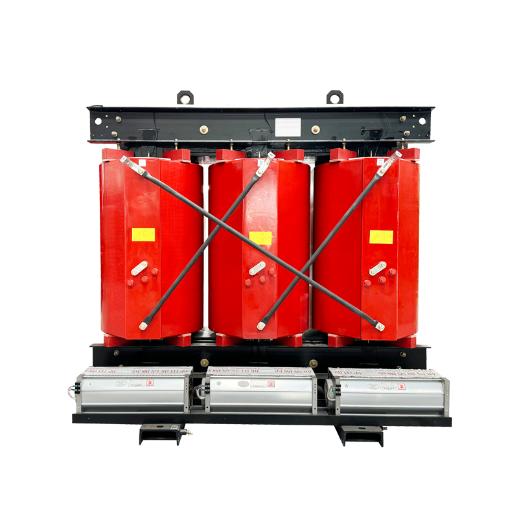
Dry Type Transformer for Commercial Building: Sizing, Codes & Selection

A dry type transformer is the standard choice for commercial buildings because it uses air or solid insulation instead of flammable oil. This removes fire and spill risks inside occupied structures and simplifies compliance with indoor electrical codes.
But choosing the right unit involves more than picking a nameplate kVA. Office towers, hotels, retail stores, and mixed-use developments each create different load profiles, harmonic challenges, and space constraints. A transformer that works well in one building type can be noisy, oversized, or undersized in another.
In this guide, you will learn how to select and size a dry type transformer for commercial building projects. We cover commercial building transformer sizing by building type, interpret the NEC Article 450 dry type transformer rules that affect room design, select between cast resin and VPI construction, manage harmonics from LED and VFD loads, and control noise in tenant spaces. You will also get a procurement checklist you can use on your next project.
Key Takeaways
- Dry type transformers are preferred for commercial buildings because they eliminate oil spill and fire risks, reducing room construction and insurance costs.
- Office buildings typically need 500–2,500 kVA, hotels 300–1,600 kVA, and retail stores 200–2,500 kVA, depending on load density and occupancy.
- NEC 450.21 requires dry type transformers over 112.5 kVA installed indoors to be in a 1-hour fire-rated room unless protected by automatic sprinkler.
- Modern commercial loads with LED lighting, VFDs, and UPS often require K-9 to K-13 rated transformers to handle harmonic heating.
- Cast resin transformers offer the best fire safety (F1 rating) and moisture resistance, while VPI transformers provide a lower-cost option for standard indoor environments.
Why Commercial Buildings Use Dry Type Transformers
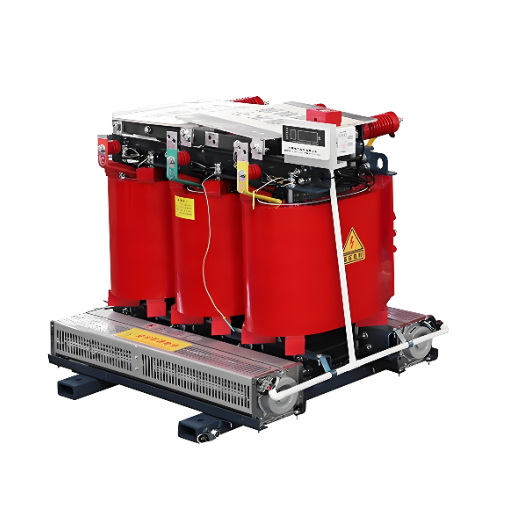
Commercial developments rarely have space for outdoor oil-filled substations. They also cannot tolerate the environmental liability of an oil leak inside a basement or mechanical room. Dry type transformers solve both problems.
Fire Safety and Indoor Installation
Dry-type transformers use air, epoxy resin, or vacuum-pressure-impregnated insulation rather than mineral oil. Because there is no liquid coolant, the fire hazard is far lower. This is why most indoor transformer installations in offices, hotels, and retail centers use dry type designs.
No Oil Containment or Spill Risk
Oil-immersed transformers require containment pits, oil-water separators, and spill response planning. Dry type units need none of this infrastructure. The electrical room can be smaller and the insurance underwriter often treats the installation more favorably. For outdoor or large-capacity applications, an oil immersed transformer may still be the better choice.
Lower Infrastructure Cost vs. Oil-Filled Units
Even when the transformer itself costs slightly more, the total installed cost usually favors dry type for indoor commercial projects. You avoid oil containment construction, ventilation for hydrocarbon vapor, and the long-term cost of oil testing and disposal.
Maintenance Simplicity in Occupied Buildings
Dry type transformers need visual inspection, cleaning, and thermal monitoring, but they do not require annual oil sampling. For facility managers responsible for tenant uptime, that simplicity matters. Our three-phase dry type transformer guide explains the core construction options in more detail.
Dry Type Transformer Sub-Types for Commercial Buildings
Not every dry-type transformer suits every commercial project. The three main subtypes differ in cost, fire behavior, moisture resistance, and noise.
Cast Resin Transformers
Cast resin transformers encapsulate the windings in epoxy resin under vacuum. They are self-extinguishing, moisture-resistant, and mechanically robust. For a cast resin transformer commercial building application, the F1 fire behavior rating and low smoke emission are strong advantages where evacuation routes or tenant spaces are nearby.
VPI Transformers
Vacuum pressure impregnated (VPI) transformers use polyester or epoxy resin applied under vacuum and pressure. A VPI transformer commercial building installation is the most common choice for standard office and retail electrical rooms. It costs less than cast resin while still providing good fire performance and long service life.
Open Ventilated Transformers
Open ventilated units rely on natural airflow and are best suited for clean, climate-controlled electrical rooms. They are lighter and less expensive, but they require better filtration and are less tolerant of dust or humidity.
When to Choose Each for Commercial Projects
Choose cast resin when fire safety is critical, the room is humid, or the unit may be exposed to occasional condensation. Choose VPI for typical indoor installations where first cost matters. Choose open ventilation only when the environment is clean, dry, and well maintained.
| Sub-Type | Fire Behavior | Moisture Resistance | Typical Cost | Best For |
|---|---|---|---|---|
| Cast resin | F1, self-extinguishing | Excellent | Highest | Hotels, hospitals, high-rise, humid locations |
| VPI | Good, low smoke | Good | Moderate | Offices, retail, standard electrical rooms |
| Open ventilated | Standard | Limited | Lowest | Clean, climate-controlled rooms |
This table gives a quick reference for project meetings where the team must decide between a cast resin transformer commercial building installation and a VPI transformer commercial building installation.
Commercial Building Types and Transformer Requirements
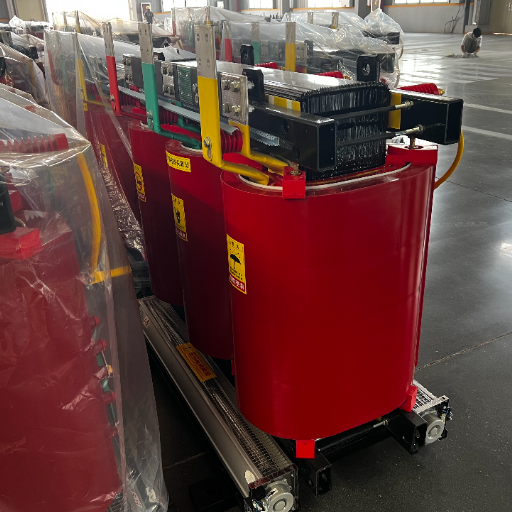
Commercial building transformer sizing must match the actual load profile. Hotels, offices, and retail centers look similar from the outside but demand very different power calculations. For context on how transformers fit into the broader utility-to-building path, see our overview of what is a distribution transformer.
Office Buildings
A dry type transformer for office building applications typically serves lighting, HVAC chillers and air handlers, elevators, plug loads, and small server or IT rooms. Ratings commonly range from 500 kVA for small multi-tenant buildings to 2,500 kVA for large high-rise floors. Noise is a major concern because transformer rooms often sit near occupied tenant space.
Hotels and Hospitality
A dry type transformer for hotel use must handle guest room loads, corridor lighting, kitchen equipment, laundry, pool pumps, and event spaces. Ratings usually fall between 300 kVA and 1,600 kVA. Because hotels operate 24 hours per day, redundancy and low-night noise matter more than in offices. A dry type transformer for hotel projects should also consider guest comfort ratings and vibration isolation near occupied floors.
Retail Stores and Shopping Malls
A dry type transformer for retail application faces high lighting density, refrigerated cases, HVAC, point-of-sale systems, and food court loads. Stand-alone stores may need only 200 kVA, while a dry transformer for shopping mall anchor tenants can reach 2,500 kVA. Tenant turnover also means future load growth should be planned early. A dry type transformer for retail rollout programs should be standardized to simplify permitting and spare parts across multiple locations.
Mixed-Use Developments
Mixed-use buildings combine retail, office, residential, and parking loads. Diversity factors are high because all loads rarely peak at the same time. Transformer banking or a single larger unit can be more economical than separate transformers for each use, but metering and electrical segregation must be planned from the start.
Sizing a Dry Type Transformer for Commercial Buildings
Commercial building transformer sizing is the single most important specification decision. Undersizing leads to overheating and premature failure. Oversizing wastes capital, increases no-load losses, and reduces efficiency at part load.
Step 1: Calculate Connected Load
Add the nameplate ratings of all expected loads: lighting, HVAC motors, elevators, kitchen equipment, data racks, and receptacle circuits. This is the connected load. It is always higher than the actual operating load.
Step 2: Apply Demand and Diversity Factors
Not every load runs at full power simultaneously. Demand factors reduce the calculated load based on expected usage. Diversity factors account for the fact that different tenant types peak at different times. For commercial buildings, diversity often ranges from 60% to 80%.
Step 3: Add NEC 125% Continuous Load Factor
The National Electrical Code requires continuous loads to be sized at 125% of the calculated load. This is a safety margin that prevents the transformer from running at 100% capacity during normal operation.
Step 4: Include Future Growth Margin
Add 15% to 25% for future tenants, equipment additions, or building expansion. Rewiring or replacing a transformer after occupancy is far more expensive than sizing correctly at the start.
Step 5: Account for Harmonics and K-Factor
Non-linear loads such as LED drivers, variable frequency drives (VFDs), and UPS systems create harmonic currents. These increase heating in the transformer and neutral conductor. A K-factor transformer commercial building design may be required when non-linear loads exceed 35% to 50% of the total.
Worked Example: 10-Story Office Building
A 10-story office building has a connected load of 2,000 kVA. After applying a 70% diversity factor, the diversified load is 1,400 kVA. Adding the 125% continuous load factor gives 1,750 kVA. With 20% future growth, the target size is 2,100 kVA. The project engineer selects a 2,000 kVA dry type transformer for office building service with a K-13 rating to handle LED and VFD loads.
A developer in Dallas once installed a 750 kVA unit in a 12-story office building based on nameplate load totals alone. Within 18 months, the building reached 85% occupancy and the transformer ran at 95% load on summer afternoons. Overheating alarms became common, and the landlord faced $28,000 in emergency cooling upgrades and load shedding. A proper commercial building transformer sizing study would have specified 1,250 kVA from the start.
NEC Article 450 Dry Type Transformer Fire Safety Requirements
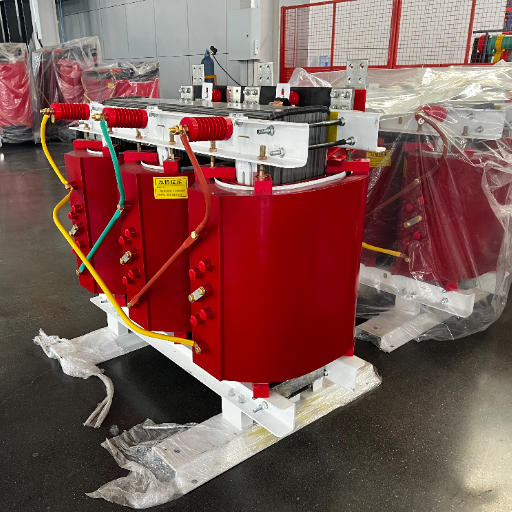
Indoor transformer installations in commercial buildings are governed by NEC Article 450. Understanding these rules early prevents costly redesign of electrical rooms.
NEC 450.21 Fire-Rated Room Rules
NEC 450.21(B) requires dry type transformers over 112.5 kVA installed indoors to be located in a transformer room of fire-resistant construction. The room must have a minimum 1-hour fire rating unless the transformer is protected by automatic sprinkler, deluge, or carbon dioxide systems.
Sprinkler Substitution for Fire-Rated Construction
In many jurisdictions, an automatic sprinkler system installed in the transformer room can substitute for part of the fire-rated construction requirement. Always confirm this with the Authority Having Jurisdiction (AHJ) and the local fire marshal before finalizing room design.
Clearance from Combustible Materials
Dry type transformers must maintain minimum clearances from combustible walls, ceilings, and stored materials. Exact distances depend on transformer voltage, kVA, and enclosure type. A common rule of thumb is 12 to 18 inches minimum, but project drawings should reference the manufacturer’s installation manual and local amendments.
Authority Having Jurisdiction Coordination
NEC provides the baseline, but local amendments can be stricter. Early coordination with the AHJ, architect, and fire protection engineer prevents last-minute changes that delay occupancy permits. The NFPA National Electrical Code resources provide the authoritative reference for code language.
Noise, Ventilation, and Electrical Room Design
Transformers generate sound and heat. In commercial buildings, both must be managed carefully to protect tenant comfort and equipment life.
Typical Noise Limits for Commercial Spaces
Standard dry type transformers produce 55 to 65 dB at 1 meter. Low-noise designs with high-quality core steel can achieve 45 to 50 dB. For hotels, conference centers, and office tenant areas, aim for the lower end of this range.
Ventilation and Heat Load Calculations
A 1,000 kVA dry type transformer produces approximately 11,500 W of heat at full load. The electrical room ventilation system must remove this heat or the transformer will derate. In hot climates, this heat load is equivalent to a small residential air conditioner running continuously.
Vibration Isolation and Structure-Borne Noise
Sound ratings measure airborne noise in free field conditions. In real buildings, vibration transmitted through the floor and walls can be more noticeable than airborne hum. Neoprene pads, spring isolators, and flexible conduit connections reduce structure-borne noise.
Electrical Room Location and Expansion Space
Locate transformer rooms away from quiet tenant spaces when possible. Provide adequate working clearance in front of and around each unit. Plan space for a future second transformer or switchgear expansion. Building owners often regret cramped electrical rooms ten years after construction.
Need help sizing your electrical room? Contact our engineering team with your floor plans and load schedule for a layout review.
Harmonic Considerations in Commercial Buildings
Modern commercial buildings are filled with non-linear loads. These loads reduce power quality and increase transformer heating.
Sources: LED Lighting, VFDs, UPS, Computers
LED drivers, variable frequency drives, uninterruptible power supplies, and electronic ballasts draw current in short pulses rather than smooth sine waves. This creates harmonic currents that distort voltage and increase losses in transformers, neutrals, and motors.
K-Factor Selection (K-4, K-9, K-13)
K-factor transformers are designed to handle harmonic heating without excessive loss of life. K-4 suits buildings with modest non-linear loads. K-9 and K-13 are common for office buildings with high LED and IT loads. Severe harmonic environments may require K-20 or active filtering.
Neutral Sizing for Triplen Harmonics
Triplen harmonics (3rd, 9th, 15th) add arithmetically in the neutral conductor. In some designs, the neutral must be sized to 1.45 times the phase current. Oversizing the neutral during rough-in is far cheaper than rewiring after tenant complaints.
When to Add Active Harmonic Filters
When total harmonic distortion exceeds 15% to 20%, or when sensitive equipment shares the same transformer, active harmonic filters may be the best solution. K-factor transformers handle the heat, but filters clean the waveform itself. For more on efficiency and loss management, see our guide to transformer efficiency.
Cost Breakdown for Commercial Building Projects
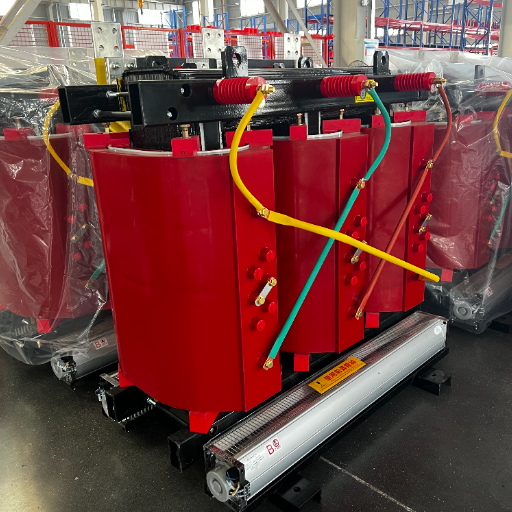
The purchase price of the transformer is only part of the project budget. Total installed cost includes equipment, delivery, installation, room construction, ventilation, and commissioning.
Equipment Cost by kVA Rating
Dry type transformer equipment costs vary by sub-type, voltage class, efficiency tier, and enclosure. As a rough guide for budget planning, cast resin units typically cost 15% to 25% more than equivalent VPI units. Higher K-factor ratings and low-noise cores also add cost.
Installation Cost Components
Installation includes rigging, anchoring, bus duct or cable termination, control wiring, testing, and commissioning. In tight urban buildings, crane access and after-hours rigging can add thousands to the installation budget.
Total Installed Cost Examples
Total installed cost for a commercial building dry type transformer typically ranges from 1.5x to 2.5x the equipment cost. A 1,000 kVA VPI transformer in a standard office electrical room might have a total installed cost between 45,000 and 45,000 and 80,000, depending on location and infrastructure. A cast resin transformer commercial building installation in a high-rise with complex rigging may run higher.
A national retail chain upgrading 40 stores standardized on 300 kVA cast resin transformers with IP31 enclosures. The higher upfront cost compared to VPI was offset by eliminating oil containment concerns, reducing insurance premiums, and simplifying permitting in jurisdictions with strict fire codes. Store openings were delayed in only one location where the AHJ required additional ventilation, a problem caught early by a standard checklist.
Procurement Checklist for Commercial Building Transformers
Use this checklist before issuing a transformer specification or requesting quotations:
- Building type and load profile — office, hotel, retail, or mixed-use.
- Sub-type selection — cast resin, VPI, or open ventilated.
- kVA rating — calculated with diversity, NEC 125% factor, and growth margin.
- Primary and secondary voltage — match utility supply and building distribution. For guidance on voltage transformation direction, see our step up transformer vs step down transformer guide.
- K-factor rating — K-4, K-9, K-13, or higher based on non-linear load share.
- Fire behavior class — F0 or F1 under IEC 60076-11 for indoor safety. The IEC publishes the international test methods that define these fire behavior classes.
- IP / NEMA enclosure rating — match electrical room conditions.
- Noise level — specify dB limit at 1 meter for tenant-sensitive locations.
- Efficiency standard — DOE 2016, NEMA TP-1, or local requirements. NEMA provides transformer efficiency standards widely referenced in North American specifications.
- Manufacturer documentation — test reports, installation drawings, and warranty terms.
A boutique hotel in Chicago placed a 1,000 kVA VPI transformer in a mechanical room behind the front desk. The unit produced 63 dB, within specification but audible in the lobby. Guests on the first floor reported a low hum in reviews. The owner installed acoustic insulation and vibration pads for $14,000, reducing perceived noise by 40%. The lesson is that free-field noise ratings do not account for structure-borne sound in occupied spaces.
Ready to specify your unit? Send your building type, estimated load, and electrical room details to our team for a dry type transformer recommendation and quotation.
Frequently Asked Questions
Why use a dry type transformer in a commercial building?
Dry type transformers eliminate oil spill and fire risks, reduce infrastructure cost, and simplify indoor installation. They are the standard choice for occupied commercial buildings where safety and maintenance access matter.
What size transformer does a commercial building need?
Office buildings typically need 500–2,500 kVA, hotels 300–1,600 kVA, and retail stores 200–2,500 kVA. Exact sizing requires a load study with demand factors, NEC continuous load margins, and future growth.
Do dry type transformers need a fire-rated room?
NEC 450.21(B) requires dry type transformers over 112.5 kVA installed indoors to be in a transformer room with a minimum 1-hour fire rating unless protected by automatic sprinkler or other approved fire protection.
What is the difference between cast resin and VPI transformers for commercial buildings?
Cast resin transformers encapsulate windings in epoxy for superior fire safety, moisture resistance, and mechanical strength. VPI transformers offer a lower-cost standard indoor solution with good performance in clean electrical rooms.
How do you reduce transformer noise in an office building?
Specify low-noise core designs, provide vibration isolation, use flexible connections, add acoustic barriers, and locate transformer rooms away from quiet tenant spaces. Always consider structure-borne as well as airborne noise.
What K-factor is needed for commercial buildings?
Buildings with 35% to 50% non-linear load usually need K-9 or K-13 transformers. Severe harmonic environments with high LED, VFD, or UPS loads may require K-20 or active harmonic filtering.
Can dry type transformers be installed in a basement?
Yes, dry type transformers are commonly installed in basements and parking levels. The electrical room must have proper ventilation, fire-rated construction or sprinkler protection, and adequate working clearances.
How much does a dry type transformer cost for a commercial building?
Equipment cost depends on kVA, sub-type, and features. Total installed cost typically ranges from 1.5x to 2.5x equipment cost, including room construction, ventilation, rigging, and commissioning.
Conclusion
Selecting the right dry type transformer for commercial building projects requires more than matching a kVA rating to a load schedule. The right choice depends on building type, indoor fire codes, harmonic content, noise limits, and total installed cost. Cast resin units provide the highest fire safety and moisture resistance. VPI units offer strong value for standard indoor electrical rooms. K-factor ratings protect against harmonic heating from modern LED and VFD loads.
A well-planned dry type transformer for commercial building installation starts with a detailed load study, early coordination with the AHJ, and realistic assumptions about future growth. The cost of oversizing or undersizing is almost always higher than the cost of a careful sizing study. Attention to electrical room ventilation, structure-borne noise, and neutral sizing also separates successful installations from projects that generate tenant complaints.
If you are planning an office, hotel, retail, or mixed-use development, send your voltage, load profile, and electrical room details to Shandong Electric Co., Ltd.. Our engineering team will recommend the most practical dry type transformer for your commercial building and provide a competitive quotation backed by export-ready manufacturing and technical support.