
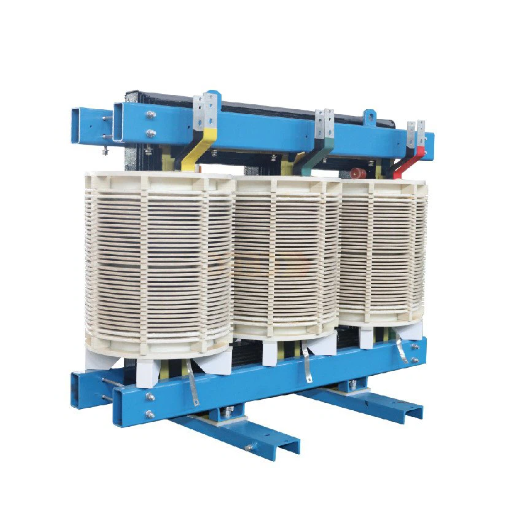
Indoor Dry Transformer: Selection, Room Design & Building Integration Guide

An indoor dry transformer is the safest, most code-compliant choice for bringing medium-voltage power into occupied buildings because it uses solid or air insulation instead of flammable oil, eliminating fire vaults, containment pits, and spill hazards. Whether you are designing a hospital, data center, hotel, or shopping mall, the transformer room is too often an afterthought — and that oversight can cost tens of thousands in rework.
Last year in Toronto, a hospital renovation team installed a 1,500 kVA dry-type unit in a basement electrical room with standard gypsum walls. During final inspection, the fire marshal required a 2-hour fire-rated separation because the room sat below an occupied patient ward and lacked automatic suppression. Reworking walls, doors, and firestopping cost $18,000 and delayed occupancy by three weeks. Dry type transformers may not need oil containment, but they still demand proper room design, ventilation, noise control, and code-compliant fire separation.
This guide walks you through selecting the right indoor dry transformer for your building type, designing the electrical room around it, and avoiding the mistakes that trigger expensive change orders.
Want the complete picture of all dry type transformer types? See our dry type transformer guide covering cast resin, VPI, and open ventilated designs.
Key Takeaways
- Indoor dry transformers eliminate oil containment and fire suppression vaults, cutting room construction costs by 30-50% compared to oil-filled units.
- Standard units produce 55-65 dB at 1 meter; low-noise designs achieve 45-50 dB for hospitals and hotels where tenant comfort matters.
- Total installed cost ranges from 1.5-2.0x equipment cost in simple commercial buildings to 3.0-4.0x in data centers with redundancy requirements.
- Buildings with more than 20% non-linear load (LED lighting, VFDs, UPS) should specify K-rated transformers to prevent harmonic overheating.
- A 1,000 kVA dry type transformer produces approximately 11,500 W of heat at full load — roughly equivalent to a small residential HVAC system.
What Is an Indoor Dry Transformer?
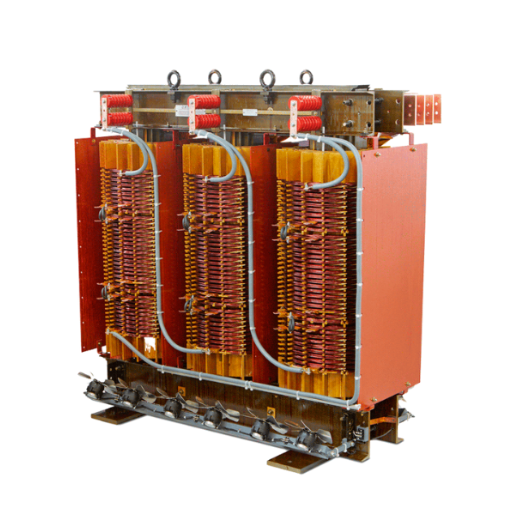
Definition and Key Characteristics
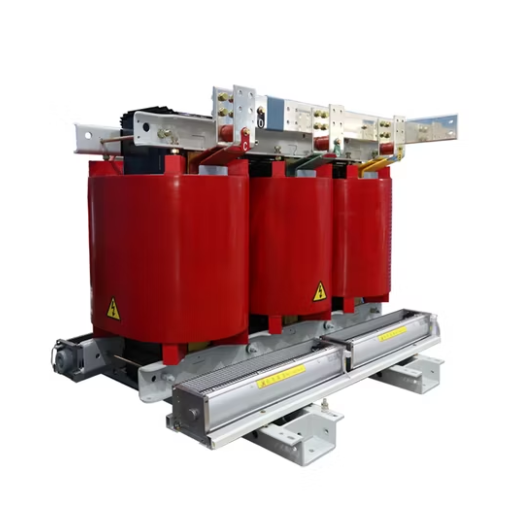
An indoor dry transformer is a static power-conversion device that relies on air, cast resin, or vacuum pressure impregnated (VPI) insulation rather than liquid dielectric. Because there is no oil inside, the unit is inherently fire-resistant and can be installed in occupied buildings without the vaults, containment pits, or oil-drainage systems required for oil-filled transformers.
Key characteristics include self-extinguishing insulation systems, minimal maintenance requirements, and compatibility with standard building fire suppression. Most indoor dry transformers carry Class F (155 C) or Class H (180 C) insulation ratings, with natural air (AN) or forced air (AF) cooling options.
How Indoor Dry Transformers Differ from Oil-Filled
The choice between dry type and oil-filled for indoor use comes down to safety, infrastructure, and lifecycle economics.
| Factor | Indoor Dry Transformer | Oil-Filled Transformer |
|---|---|---|
| Fire safety | Self-extinguishing solid insulation | Flammable liquid — requires vault or outdoor placement |
| Ventilation | Heat removal via room airflow | Oil cooling radiators, separate oil circuit |
| Maintenance | Minimal — visual inspection and cleaning | Oil testing, treatment, and filtration |
| Installation location | Adjacent to occupied spaces, basements, rooftops | Isolated vaults or outdoor pads |
| First cost per kVA | Higher equipment cost | Lower equipment cost |
| Lifecycle cost indoors | Lower — no oil maintenance or vault upkeep | Higher — oil handling, vault maintenance, spill risk |
For most occupied buildings, the added first cost of a dry type unit is recovered quickly through eliminated infrastructure and reduced maintenance.
Need help deciding between cast resin and VPI? See our cast resin transformer guide and VPI transformer guide for a detailed technology comparison.
Why Choose a Dry Transformer for Indoor Installation?
Fire Safety and Code Compliance
Indoor dry transformers satisfy the fire safety requirements of NFPA 70 (NEC) Article 450 and IEC 61936-1 without the fire-rated vaults or oil-containment systems that oil-filled units demand. In most jurisdictions, a properly located dry-type transformer in a standard electrical room meets code without additional fire-rated separation — provided the room is not directly below occupied patient wards, assembly spaces, or other high-risk areas.
Always verify requirements with the Authority Having Jurisdiction (AHJ) during the design phase, not after installation.
Environmental and Health Benefits
Because there is no oil, there is no leak risk to groundwater, building finishes, or soil. Older oil-filled units sometimes contain PCBs, creating disposal and liability concerns that simply do not exist with dry type designs. Indoor dry transformers are also compatible with green building certifications such as LEED and BREEAM, supporting projects with sustainability targets.
Reduced Infrastructure Requirements
Dry type units do not need oil containment pits, drainage trenches, or fire-suppression vaults. They are lighter than equivalent oil-filled transformers, reducing foundation loads and seismic anchoring requirements. In many kVA ratings, the overall footprint per kVA is smaller, which matters in space-constrained urban buildings.
Indoor Transformer Applications by Building Type
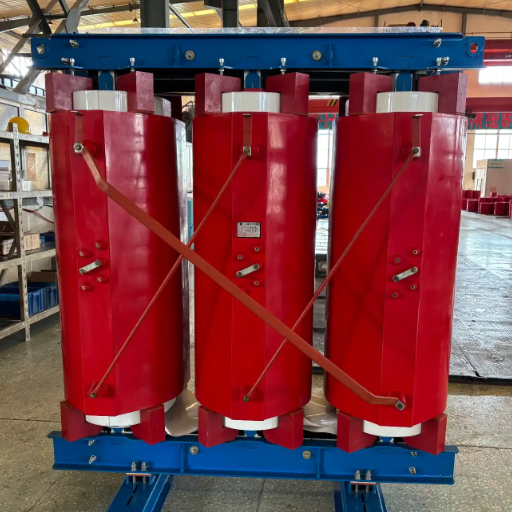
Hospitals and Healthcare Facilities
Healthcare electrical rooms sit near patient areas, so noise and reliability are non-negotiable. Low noise requirements typically call for levels below 55 dB at 1 meter. Vibration isolation pads prevent structure-borne hum from reaching patient rooms above or beside the transformer. Critical loads often require redundant transformer configurations, and harmonic-rich medical equipment demands K-factor ratings (K-4, K-13, or K-20) to prevent overheating from non-linear currents.
Data Centers
Data centers prioritize efficiency and redundancy. N+1 transformer configurations are common, and units are typically located close to UPS systems and switchgear to minimize cable runs. Temperature-controlled environments allow cast resin transformers to operate at predictable temperatures, making cast resin the preferred choice for reliability-critical deployments.
Commercial Buildings (Offices, Hotels, Retail)
Urban commercial buildings face space constraints and tenant comfort expectations. Noise sensitivity drives the specification of low-noise or acoustic-enclosure designs. Aesthetic enclosure requirements may apply in lobbies or public areas. Typical ratings range from 500 kVA to 2,500 kVA depending on building size and tenant mix.
A 5-star hotel in Singapore learned this lesson the hard way. The engineering team installed a 2,000 kVA cast resin transformer in a mechanical room adjacent to guest suites on the 8th floor. The unit produced 62 dB — within manufacturer specifications but audible through the shared wall. Within two weeks of opening, guests on three floors complained about a constant low hum affecting sleep. The hotel faced a choice: relocate the transformer to the roof at 85,000, install acoustic enclosures and vibration isolation at 85,000, or install acoustic enclosures and vibration isolation at 28,000. They chose the enclosure route, which reduced noise to 48 dB. The lesson is clear: manufacturer noise ratings measure free-field sound pressure, not structure-borne transmission through walls.
Educational Institutions
Schools and universities prioritize safety in student-occupied buildings and expect long service life — often 30 years or more. Budget constraints favor low-maintenance designs that do not require frequent oil testing or replacement.
Industrial Facilities
Indoor industrial applications expose transformers to higher dust loads, contamination, and load cycling. VPI construction is often preferred for cost-effectiveness in moderate environments. Where dust or wash-down exposure is severe, IP ratings above standard indoor levels (IP31 or IP42 instead of IP20) may be required.
Indoor Transformer Room Design Requirements
Minimum Room Dimensions and Clearances
IEC 61936-1 defines minimum clearances by kVA rating and voltage class. Practical room design must also account for door width wide enough to remove or replace the transformer without dismantling door frames, and ceiling height sufficient for lifting equipment and maintenance access above the unit.
A good rule of thumb is to add at least 1 meter of working space on the front and sides of the transformer, with rear clearances per manufacturer requirements. Always confirm exact dimensions with the specific unit’s installation manual before finalizing room drawings.
Ventilation and Thermal Management
A 1,000 kVA dry type transformer produces roughly 11,500 W of heat at full load — equivalent to a small residential HVAC system. If that heat is not removed, ambient temperature in the room climbs, accelerating insulation aging and reducing service life.
Natural ventilation through louvered openings works for smaller units in temperate climates. Forced ventilation with exhaust fans becomes necessary for larger ratings, high ambient temperatures, or rooms with limited exterior wall area. Heat load calculations should use maximum ambient conditions, not annual averages, because a transformer does not get cooler on the hottest day of the year.
A shopping mall developer in Mumbai allocated a 3m x 4m room for two 1,600 kVA dry type transformers in the basement parking level. The room had no ventilation openings — the architect assumed the basement ambient would suffice. During the first summer, with parking level temperatures reaching 38 C and transformer heat adding another 15 C, both units tripped on overtemperature during peak shopping hours. The mall lost power to 40% of tenants for six hours. Adding louvered ventilation and two exhaust fans cost 12,000.Properventilationdesignduringconstructionwouldhavecost12,000.Properventilationdesignduringconstructionwouldhavecost3,000.
Fire Safety and Separation
Dry type transformers tolerate standard sprinkler systems, but the room itself may still require fire-rated walls and doors depending on location. When a transformer room sits below occupied spaces — especially patient wards, assembly halls, or sleeping areas — many jurisdictions mandate 1-hour or 2-hour fire-rated separation. Smoke detection should tie into the building’s fire alarm system.
Noise Control and Vibration Isolation
Standard dry type transformers produce 55-65 dB at 1 meter. Low-noise designs achieve 45-50 dB for hospital and hotel applications. Structure-borne noise travels through building steel and concrete far more effectively than airborne noise, so vibration isolation pad selection matters as much as, if not more than, acoustic enclosures.
Specify noise levels before procurement, and design the room with mass-loaded walls or decoupled construction when the transformer sits adjacent to occupied spaces.
Electrical Room Location Within Buildings
Basement locations place heavy units where structural support is strongest, but ventilation and flood risk must be managed. Rooftop locations simplify heat rejection and future replacement access, but require weatherproof enclosures and longer cable runs. Intermediate floors can optimize load-center proximity, but floor loading and noise isolation become critical.
Proximity to switchgear and main distribution panels reduces cable length and voltage drop. Always allocate future expansion space — upsizing or adding a second unit is far easier when the room was designed for it from the start.
For detailed clearance and installation standards, see our dry type transformer installation guide.
Cast Resin vs VPI for Indoor Applications
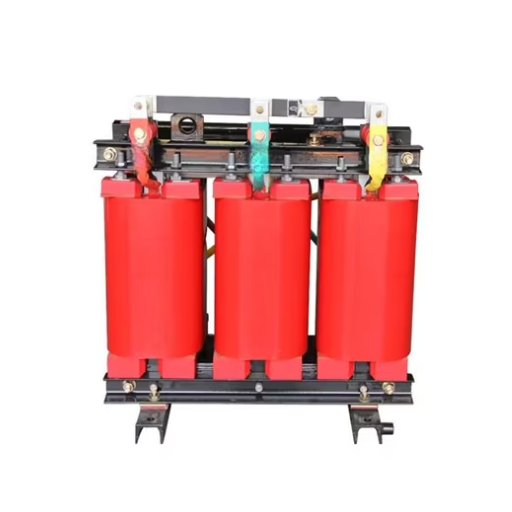
When to Specify Cast Resin Indoors
Cast resin transformers excel where reliability is paramount. Specify cast resin for hospitals, data centers, coastal environments with salt air exposure, and any application where higher fire safety ratings or minimal maintenance are worth a 15-25% equipment premium.
When to Specify VPI Indoors
VPI construction is the practical choice for cost-sensitive commercial and light industrial projects with moderate environmental conditions and periodic maintenance access. The lifecycle cost advantage shifts toward cast resin in critical applications, but VPI delivers solid performance at a lower upfront cost.
Cost Comparison by Sub-Type
| Sub-Type | Equipment Premium | Best For |
|---|---|---|
| Cast resin | 15-25% above VPI | Hospitals, data centers, harsh environments |
| VPI | Baseline | Commercial buildings, light industrial, budget projects |
Indoor Transformer Specifications and Ratings
Common Indoor Dry Transformer Ratings
- Voltage: 400 V, 690 V, and 11 kV primary are typical
- kVA: 100 to 5,000 kVA for building applications
- Insulation class: F (155 C) or H (180 C)
- Cooling: AN (natural air) or AF (forced air)
Special Ratings for Indoor Applications
Buildings with significant non-linear load — LED lighting, variable frequency drives, UPS systems — should specify K-factor transformers. K-4, K-13, and K-20 ratings prevent overheating from harmonic currents that standard transformers are not designed to handle. Buildings with more than 20% non-linear load benefit significantly from K-rated units.
IP ratings should match the environment: IP20 or IP21 for standard clean indoor rooms, IP31 or IP42 for dusty environments, and IP54 or higher for wash-down or wet areas.
Efficiency Standards
DOE 2016 efficiency standards require minimum efficiencies of 98.2% for 1,000 kVA three-phase transformers at 50% loading. Specifying compliant units reduces operating losses and supports lifecycle cost objectives.
Learn more about efficiency requirements in our transformer efficiency guide.
Cost Breakdown for Indoor Dry Transformer Projects
Equipment Cost by Rating
| kVA Rating | Equipment Cost (USD) |
|---|---|
| 500 kVA | $4,000 – 7,000 |
| 1,000 kVA | $7,000 – 12,000 |
| 2,000 kVA | $12,000 – 20,000 |
| 2,500 kVA | $15,000 – 25,000 |
Installation Cost Components
Total installed cost includes room construction and finishes, foundation and seismic anchoring, electrical connections and bus duct, ventilation system integration, fire suppression and detection, and testing and commissioning.
Total Installed Cost Examples
| Building Type | Multiplier on Equipment Cost |
|---|---|
| Simple commercial installation | 1.5 – 2.0x |
| Hospital with noise and fire requirements | 2.5 – 3.5x |
| Data center with redundancy | 3.0 – 4.0x |
The multiplier reflects room construction quality, acoustic treatment, fire-rated separation, and redundancy infrastructure rather than the transformer itself.
Common Indoor Installation Mistakes
Mistake 1: Inadequate Ventilation
Chronic overheating and reduced service life result when rooms are sized without heat-load calculations. Prevention: calculate heat rejection at maximum ambient temperature and confirm ventilation capacity year-round.
Mistake 2: Ignoring Noise Transmission
Tenant complaints and costly remediation follow when structure-borne noise is overlooked. Prevention: specify noise level before procurement and design walls for acoustic isolation when transformers abut occupied spaces.
Mistake 3: Insufficient Maintenance Access
Testing, inspection, or replacement can require partial building shutdown if doorways and ceiling heights were not planned for component removal. Prevention: design the room for full transformer replacement without demolition.
Mistake 4: Wrong Insulation Class for Load Profile
Premature failure from harmonic overheating occurs when standard transformers serve non-linear loads. Prevention: specify K-factor ratings for buildings with significant VFD, LED, or UPS load.
Mistake 5: Fire Separation Non-Compliance
Inspection failures and costly rework happen when AHJ fire-rating requirements are verified too late. Prevention: confirm fire separation and suppression requirements with the authority having jurisdiction during the design phase, not after installation.
Frequently Asked Questions
What is an indoor dry transformer?
An indoor dry transformer is a power distribution transformer that uses air, cast resin, or VPI insulation instead of liquid oil. This makes it safe for installation inside occupied buildings without fire vaults, oil containment, or spill hazards.
Why use a dry type transformer indoors instead of an oil-filled?
Dry type transformers eliminate fire vaults, oil containment pits, and spill risks required for oil-filled units. They are lighter, require less maintenance, and can be installed near occupied spaces under most building codes.
What are the indoor transformer room ventilation requirements?
Ventilation must remove the heat generated by the transformer at maximum load and highest ambient temperature. A 1,000 kVA unit produces about 11,500 W of heat. Natural ventilation works for smaller units; forced exhaust is often needed for larger ratings or high-ambient climates.
How do you reduce transformer noise in buildings?
Specify low-noise units (45-50 dB for sensitive applications), install vibration isolation pads to block structure-borne transmission, and use mass-loaded or decoupled wall construction between the transformer room and occupied spaces.
What are indoor transformer fire safety requirements?
Dry type transformers meet NEC Article 450 and IEC 61936-1 without oil vaults, but the room itself may require fire-rated walls, rated doors, and smoke detection depending on location — especially when below occupied patient wards or assembly spaces.
What is the difference between cast resin and VPI for indoor use?
Cast resin offers higher reliability, better fire safety, and lower maintenance — ideal for hospitals and data centers at a 15-25% premium. VPI is cost-effective for standard commercial and light industrial buildings with moderate environments.
What kVA rating do I need for a commercial building?
Most office buildings, hotels, and retail centers use 500-2,500 kVA depending on total connected load, load diversity, and planned growth. An accurate load calculation considering HVAC, lighting, and plug loads is essential before specifying.
How much does an indoor dry transformer installation cost?
Equipment ranges from 4,000for500kVAto4,000for500kVAto25,000 for 2,500 kVA. Total installed cost is typically 1.5-4.0x equipment cost depending on building type, with simple commercial at the low end and data centers or hospitals at the high end.
Conclusion
Selecting and integrating an indoor dry transformer is not simply about choosing a kVA rating. It is about matching insulation technology, noise control, ventilation, fire safety, and room design to the specific building type and occupancy requirements.
The most expensive transformer is the one that has to be moved, enclosed, or upgraded after installation because the room was treated as an afterthought. Get the room design, ventilation, and code compliance right during construction, and the transformer will deliver 30-40 years of reliable service with minimal intervention.
Ready to specify an indoor dry transformer for your project? Send us your building type, load profile, and room dimensions, and our engineering team will recommend the most practical configuration for reliability, safety, and long-term value.